>
Clupeiformes (Herrings) >
Dorosomatidae (Gizzard shads and sardinellas)
Etymology: Sardinella: Latin and Greek, sarda = sardine; name related to the island of Sardinia; diminutive (Ref. 45335).
More on author: Valenciennes.
Περιβάλλον: περιβάλλον / κλιματική ζώνη / εύρος βάθους / εύρος διανομής
Οικολογία
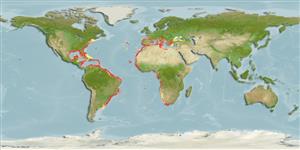
Θαλασσινό(ά); Υφάλμυρο pelagic-neritic; ωκεανόδρομο(ς) (Ref. 51243); εύρος βάθους 0 - 350 m (Ref. 188). Subtropical; 18°C - 25°C (Ref. 2945); 47°N - 40°S, 98°W - 43°E (Ref. 54867)
Atlantic Ocean: West African coast (Ref. 2849, 3509, 5286, 121197) from Gibraltar southward to Saldanha Bay in South Africa (Ref. 188, 81269, 81631), especially in the three West African upwelling areas, from Mauritania to Guinea, from Côte d'Ivoire to Ghana and from Gabon to Angola (Ref. 121197); also in Mediterranean Sea (Ref. 188, 6683, 81631) and Black Sea (Ref. 188, 6683). In western Atlantic Ocean from Cape Cod in USA to Argentina (Ref. 188, 5286), including Bahamas, Antilles, Gulf of Mexico and the Caribbean coast (Ref. 26938).
Μήκος κατά την πρώτη ωρίμανση / Μέγεθος / Βάρος / Ηλικία
Γεννητική Ωρίμανση: Lm 18.8, range 13 - 25 cm
Max length : 41.0 cm TL αρσενικό/απροσδιόριστο; (Ref. 825); common length : 25.0 cm SL αρσενικό/απροσδιόριστο; (Ref. 188); μεγ. δημοσιευμένο βάρος: 420.00 g (Ref. 86940); μεγ. αναφερόμενη ηλικία: 7 έτη (Ref. 839)
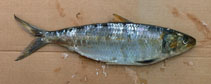
Ραχιαίες άκανθες (συνολικά) : 0; Μαλακές ραχιαίες ακτίνες (συνολικά) : 17 - 20; Εδρικές άκανθες: 0; Μαλακές εδρικές ακτίνες: 16 - 18; Σπόνδυλοι: 47 - 49. Diagnosis: Body elongate, usually subcylindrical, but sometimes a little compressed; belly rather rounded, but with a distinct keel of scutes; lower gillrakers fine and numerous, more than 80; anterior gillrakers on lower limbs of second and third gill arches lying more or less flat (Ref. 188, 2945, 81269, 81631). Flanks silvery, with a faint golden midlateral line, preceded by a faint golden spot behind gill opening; a distinct black spot at hind border of gill cover (Ref. 188). The pelvic finray count of 1 unbranched and 8 branched rays distinguishes Sardinella aurita from all other species of Sardinella, also Harengula, Opisthonema, Herklotsichthys and Amblygaster, that occur with it (Ref. 188). It resembles Clupea, but has two fleshy outgrowths along outer margin of gill opening and numerous fine fronto-parietal striae on top of head (Ref. 188).
Body shape (shape guide): elongated; Cross section: compressed.
A coastal, pelagic, species preferring clear saline waters, usually with maximum temperatures below 24°C (Ref. 27121). Found inshore and near surface to edge of shelf and down to 350m, or perhaps even deeper; schooling and strongly migratory, often rising to surface at night and dispersing (Ref. 188, 6683). It is a cold water species, temperatures between 18-25°C, approaching the coast and shoaling near the surface in the period of upwelling, but retreating below the thermocline in the hot season, down to depths of 200 to 300m (Ref. 2945, 3259). It feeds mainly on zooplankton, especially copepods and larvae of mysids, but also some phytoplankton, especially by juveniles (Ref. 188, 27121, 86940). It breeds perhaps at all times of the year, but with distinct peaks; the breeding pattern is extremely complex, with two principal spawning periods in some areas (Ref. 188). There is no spawning in Black Sea (Ref. 6683). The juveniles tend to stay in nursery areas, but on maturity rejoin adult stocks in the colder offshore waters (Ref. 188). Trematode found in intestinal tract (Ref. 37032).
The breeding pattern is extremely complex, with two principal spawning periods in some areas (linked with upwelling regimes off west Africa).
Whitehead, P.J.P., 1985. FAO Species Catalogue. Vol. 7. Clupeoid fishes of the world (suborder Clupeoidei). An annotated and illustrated catalogue of the herrings, sardines, pilchards, sprats, shads, anchovies and wolf-herrings. FAO Fish. Synop. 125(7/1):1-303. Rome: FAO. (Ref. 188)
Κατάσταση Κόκκινου Καταλόγου IUCN (Ref. 130435: Version 2025-2 (Global))
Απειλή για τον άνθρωπο
Harmless
Ανθρώπινες χρήσεις
αλιεία: πολύ εμπορικό; δόλωμα: usually
Εργαλεία
Ειδικές εκθέσεις
Λήψη XML
Διαδικτυακές πηγές
Εκτιμήσεις βάσει μοντέλων
Προτιμώμενη θερμοκρασία (Αναφ.
123201): 13.3 - 26.3, mean 18.8 °C (based on 552 cells).
Δείκτης φυλογενετικής ποικιλότητας (Αναφ.
82804): PD
50 = 0.5000 [Uniqueness, from 0.5 = low to 2.0 = high].
Bayesian length-weight: a=0.00692 (0.00606 - 0.00789), b=3.04 (3.01 - 3.07), in cm total length, based on LWR estimates for this species (Ref.
93245).
Τροφικό Επίπεδο (Αναφ.
69278): 3.4 ±0.5 se; based on diet studies.
Generation time: 2.5 (2.1 - 3.1) years. Estimated as median ln(3)/K based on 31
growth studies.
Ελαστικότητα (Αναφ.
120179): Υψηλό, ελάχιστος χρόνος για διπλασιασμό πληθυσμού < 15 μήνες (K=0.25-1.2; tm=1; tmax=7).
Prior r = 0.65, 95% CL = 0.43 - 0.98, Based on 1 full stock assessment.
Ευπάθεια στην αλιεία (Ref.
59153): Low to moderate vulnerability (29 of 100).
🛈
Ευπάθεια στο κλίμα (Ref.
125649): Low vulnerability (7 of 100).
🛈
Θρεπτικά συστατικά (Ref.
124155): Calcium = 89 [50, 191] mg/100g; Iron = 1.46 [0.87, 2.44] mg/100g; Protein = 21.6 [20.9, 22.4] %; Omega3 = 0.541 [0.271, 1.052] g/100g; Selenium = 63.2 [32.8, 112.9] μg/100g; VitaminA = 13.1 [4.2, 39.8] μg/100g; Zinc = 0.656 [0.490, 0.983] mg/100g (wet weight); based on
nutrient studies.