Umwelt: Milieu / Klimazone / Tiefenbereich / Verbreitungsgebiet
Ökologie
seewasser demersal; tiefenbereich 80 - 230 m (Ref. 27966). Temperate
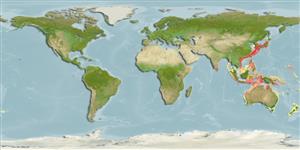
Indo-West Pacific: southern Japan and East China Sea. Specimens recorded from Indonesia, the Arafura Sea (Ref. 9819) and northwestern Australia (Ref. 5978) are probably new species (Ref. 13666).
Größe / Gewicht / Alter
Geschlechtsreife: Lm ? range ? - ? cm
Max length : 30.0 cm SL Männchen/unbestimmt; (Ref. 559)
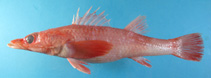
Afterflossenstacheln: 0; Afterflossenweichstrahlen: 13 - 14. Head depressed. Body without large scute-like spines. Infraorbital bones forming a strong ridge, confluent with uppermost preopercular spine and having 4-6 spines. Ratio of pectoral-fin length to caudal fin length 0.88 to 1.05 (Ref. 40506).
Body shape (shape guide): elongated.
Found in the continental shelf (Ref. 7300). Inhabit sand or sandy mud bottoms (Ref. 11230). Neither anterolateral glandular groove nor venom gland is present (Ref. 57406).
Lebenszyklus und Paarungsverhalten
Geschlechtsreife | Fortpflanzung | Ablaichen | Eier | Fruchtbarkeit | Larven
Imamura, H. and L.W. Knapp, 1998. Review of the genus Bembras Cuvier, 1929 (Scorpaeniformes: Bembridae) with description of three new species collected from Australia and Indonesia. Ichthyol. Res. 45(2):165-178. (Ref. 27966)
IUCN Rote Liste Status (Ref. 130435: Version 2025-2 (Global))
Bedrohung für Menschen
Harmless
Nutzung durch Menschen
Tools
Zusatzinformationen
Download XML
Internet Quellen
Schätzungen auf der Grundlage von Modellen
Bevorzugte Temperatur (Ref.
123201): 11.1 - 26.4, mean 19.7 °C (based on 185 cells).
Phylogenetischer Diversitätsindex (Ref.
82804): PD
50 = 0.5315 [Uniqueness, from 0.5 = low to 2.0 = high].
Bayesian length-weight: a=0.00389 (0.00180 - 0.00842), b=3.12 (2.94 - 3.30), in cm total length, based on all LWR estimates for this body shape (Ref.
93245).
Trophische Ebene (Ref.
69278): 3.8 ±0.4 se; based on size and trophs of closest relatives
Anfälligkeit der Fischerei (Ref.
59153): Low to moderate vulnerability (27 of 100).
🛈