>
Acropomatiformes (Oceanic basses) >
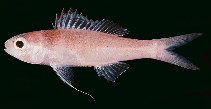
Symphysanodontidae (Slopefishes)
Etymology: Symphysanodon: Greek, syn, symphysis = grown together + Greek, physis = growth body form + Greek, odous = teeth; related to few teeth which are located over the area where the two jaws meet (Ref. 45335).
Ambiente: milieu / zona climatica / distribuzione batimetrica / gamma di distribuzione
Ecologia
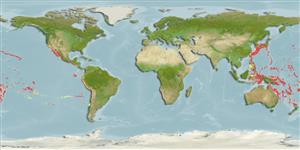
marino benthopelagico; distribuzione batimetrica 131 - 705 m (Ref. 54833), usually 150 - 500 m (Ref. 54833). Tropical; 38°N - 37°S, 119°E - 72°W
Pacific Ocean: off Japan and Lombok, Indonesia to the Hawaiian Islands and Sala y Gómez Ridge.
Dimensione / Peso / Età
Maturità: Lm ? range ? - ? cm
Max length : 16.0 cm SL maschio/sesso non determinato; (Ref. 9831); common length : 9.0 cm SL maschio/sesso non determinato; (Ref. 9831)
This species is frequently consumed by the lutjanid Pristipomoides zonatus at Pathfinder Reef, Mariana Archipelago (Ref. 9831).
Ciclo vitale e comportamento di accoppiamento
Maturità | Riproduzione | Deposizione | Uova | Fecondità | Larve
Anderson, W.D. Jr., 1999. Symphysanodontidae. Bunquelovelies (also wampeejawed fishes, slopefishes, and shelf beauties). p. 2438-2441. In K.E. Carpenter and V.H. Niem (eds.) FAO species identification guide for fishery purposes. The living marine resources of the Western Central Pacific. Volume 4. Bony fishes part 2 (Mugilidae to Carangidae). FAO, Rome. (Ref. 9831)
Stato della Lista Rossa IUCN (Ref. 130435: Version 2025-2 (Global))
Minaccia per l'uomo
Harmless
Usi umani
Strumenti
Rapporti speciali
Scarica XML
Fonti Internet
Stime basate su modelli
Temperatura preferita (Fonte Biblio.
123201): 7 - 19.9, mean 12.6 °C (based on 400 cells).
Indice di diversità filogenetica (Fonte Biblio.
82804): PD
50 = 0.5004 [Uniqueness, from 0.5 = low to 2.0 = high].
Bayesian length-weight: a=0.00407 (0.00158 - 0.01051), b=3.12 (2.89 - 3.35), in cm total length, based on LWR estimates for this (Sub)family-body shape (Ref.
93245).
Livello trofico (Fonte Biblio.
69278): 3.5 ±0.5 se; based on size and trophs of closest relatives
Vulnerabilità della pesca (Ref.
59153): Low vulnerability (10 of 100).
🛈