>
Clupeiformes (Herrings) >
Dorosomatidae (Gizzard shads and sardinellas)
Etymology: Sardinella: Latin and Greek, sarda = sardine; name related to the island of Sardinia; diminutive (Ref. 45335).
More on author: Lowe.
Milieu: milieu / Klimaatzone / Diepte / verspreidingsgebied
Ecologie
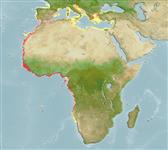
marien; brak water pelagic-neritic; oceanodroom (Ref. 51243); diepte 0 - 80 m (Ref. 27000). Subtropical; 24°C - ? (Ref. 54872); 46°N - 23°S, 17°W - 36°E (Ref. 54872)
Atlantic Ocean: southern and eastern parts of Mediterranean Sea, also penetrating the Suez Canal (Ref. 188, 50345), and eastern Atlantic Ocean, from Gibraltar southward to Angola and a single recorded specimen from Walvis Bay in Namibia (Ref. 188, 5286, 81269, 81631, 86940).
Lengte bij maturiteit / Grootte / Gewicht / Leeftijd
Maturiteit: Lm 13.4, range 11 - 19.5 cm
Max length : 30.0 cm SL mannelijk / geslacht onbekend; (Ref. 188); common length : 25.0 cm SL mannelijk / geslacht onbekend; (Ref. 188); max. gepubliceerd gewicht: 927.00 g (Ref. 3808)
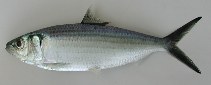
Dorsale stekels (totaal) : 0; Dorsale zachte stralen (totaal) : 18 - 23; Anale stekels: 0; Anale zachte stralen: 17 - 23; Wervels: 44 - 48. Diagnosis: Body elongate, but variable in depth, belly fairly sharply keeled; with 14-20 pre-pelvic and 12-15 post-pelvic scutes, total scutes 31-34; lower gillrakers 70-166, increasing with growth; upper pectoral finrays white on outer side, the membrane between black (Ref. 188, 3259, 81269, 81631). It resembles Sardinella aurita, but pelvic fin with 1 unbranched and 7 branched rays vs. 1 unbranched and 8 branched rays in S. aurita and no black spot on hind part of gill cover, but faint gold or black area just behind gill opening (Ref. 187, 188). It is distinguished from S. rouxi by having more lower gillrakers, which is only 30-40 in S. rouxi, and the caudal fin grey, its tips almost black vs. pale yellow with distal margin dusky in S. rouxi (Ref. 187, 188, 81269).
Body shape (shape guide): fusiform / normal; Cross section: compressed.
A coastal, pelagic species, but tolerant of low salinities (Ref. 188, 5286, 27000, 86940); sometimes in estuaries and lagoons (Ref. 188, 2683). It forms schools, preferring waters of 24°C, at surface or at bottom down to 50m, strongly migratory (Ref. 188, 5286). It feeds on a variety of small planktonic invertebrates, also fish larvae and phytoplankton (Ref. 188, 27165). It breeds only once in the year, during the warm season between July and September, in coastal waters; juveniles and adults show clear north-south migrations in the Gabon-Congo-Angola sector and the Sierra Leone-Mauritania sector of the Atlantic Ocean, each area having nurseries; these movements are correlated with the seasonal upwelling (Ref. 188). It is of considerable importance off West African coasts, but combined with Sardinella aurita in most statistics, partly because both species are often caught together (Ref. 188).
Levenscyclus en paargedrag
Maturiteit | Voortplanting | Paaien | Eieren | Fecunditeit | Larven
Whitehead, P.J.P., 1985. FAO Species Catalogue. Vol. 7. Clupeoid fishes of the world (suborder Clupeoidei). An annotated and illustrated catalogue of the herrings, sardines, pilchards, sprats, shads, anchovies and wolf-herrings. FAO Fish. Synop. 125(7/1):1-303. Rome: FAO. (Ref. 188)
Status op de Rode Lijst van het IUCN (Ref. 130435: Version 2025-2 (Global))
Gevaar voor de mens
Harmless
Gebruik door de mens
Visserij: van groot commercieel belang; aas: usually
Tools
Speciale rapporten
Download XML
Internetbronnen
Schattingen op basis van modellen
Gewenste temperatuur (Ref.
123201): 18 - 27.9, mean 21 °C (based on 208 cells).
Fylogenetische diversiteitsindex (Ref.
82804): PD
50 = 0.5000 [Uniqueness, from 0.5 = low to 2.0 = high].
Bayesian length-weight: a=0.00813 (0.00666 - 0.00992), b=3.05 (3.02 - 3.08), in cm total length, based on LWR estimates for this species (Ref.
93245).
Trofisch niveau (Ref.
69278): 3.2 ±0.38 se; based on food items.
Generation time: 3.2 (1.8 - 3.7) years. Estimated as median ln(3)/K based on 12
growth studies.
Weerstandsvermogen (Ref.
120179): Gemiddeld, minimale populatieverdubbelingstijd 1,4-4,4 jaar (K=0.34; tm=3; tmax=6).
Prior r = 0.57, 95% CL = 0.38 - 0.86, Based on 6 data-limited stock assessments.
Kwetsbaarheid van de visserij (Ref.
59153): Moderate vulnerability (35 of 100).
🛈
Kwetsbaarheid voor het klimaat (Ref.
125649): Low to moderate vulnerability (32 of 100).
🛈
Voedingsstoffen (Ref.
124155): Calcium = 112 [59, 177] mg/100g; Iron = 1.65 [0.98, 2.68] mg/100g; Protein = 21.3 [20.4, 22.1] %; Omega3 = 0.457 [0.231, 0.866] g/100g; Selenium = 39.4 [20.0, 76.9] μg/100g; VitaminA = 30.2 [9.4, 98.4] μg/100g; Zinc = 0.755 [0.542, 1.131] mg/100g (wet weight); based on
nutrient studies.