>
Atheriniformes (Silversides) >
Atherinidae (Silversides) > Craterocephalinae
Etymology: Craterocephalus: Greek, krater, -eros = bowl, mixing vessel + Greek, kephale = head (Ref. 45335).
Environnement : milieu / zone climatique / profondeur / gamme de distribution
Écologie
; eau douce benthopélagique. Tropical; 7°S - 8°S
Oceania: known only from a single collection near the junction of the Pima and Tua rivers, mountainous tributaries of the Purari River in Central Highlands, Papua New Guinea.
Taille / Poids / Âge
Maturité: Lm ? range ? - ? cm
Épines dorsales (Total) : 6 - 8; Rayons mous dorsaux (Total) : 8 - 9; Épines anales: 1; Rayons mous anaux: 9 - 10.
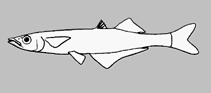
Body shape (shape guide): elongated.
Inhabits deep pools and quiet backwaters of fast-flowing gravel-bottom river.
Cycle de vie et comportement reproducteur
Maturité | Reproduction | Frai | Œufs | Fécondité | Larves
Allen, G.R., 1991. Field guide to the freshwater fishes of New Guinea. Publication, no. 9. 268 p. Christensen Research Institute, Madang, Papua New Guinea. (Ref. 2847)
Statut dans la liste rouge de l'IUCN (Ref. 130435: Version 2025-2 (Global))
Menace pour l'homme
Harmless
Utilisations par l'homme
Outils
Articles particuliers
Télécharger en XML
Sources Internet
Estimations basées sur des modèles
Indice de diversité phylogénétique (Réf.
82804): PD
50 = 0.5000 [Uniqueness, from 0.5 = low to 2.0 = high].
Bayesian length-weight: a=0.00389 (0.00180 - 0.00842), b=3.12 (2.94 - 3.30), in cm total length, based on all LWR estimates for this body shape (Ref.
93245).
Niveau trophique (Réf.
69278): 3.0 ±0.4 se; based on size and trophs of closest relatives
Résilience (Réf.
120179): Haut, temps minimum de doublement de population inférieur à 15 mois (Preliminary K or Fecundity.).
Vulnérabilité de la pêche (Ref.
59153): Low vulnerability (10 of 100).
🛈