>
Eupercaria/misc (Various families in series Eupercaria) >
Gerreidae (Mojarras)
Etymology: Gerres: Latin, gerres = a kind of anchovies; cited by Plinius.
More on author: Walbaum.
Milieu: milieu / Klimaatzone / Diepte / verspreidingsgebied
Ecologie
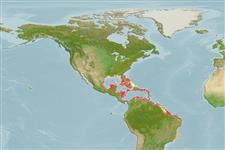
marien; zoet water; brak water rifbewoner; amfidroom (Ref. 51243); diepte 1 - 15 m (Ref. 9710). Subtropical; 33°N - 23°S, 98°W - 34°W
Western Atlantic: Bermuda and Florida, USA; Bahamas, northern Gulf of Mexico, around Caribbean, including Antilles and south American coast (Ref. 26938) to Rio de Janeiro, Brazil.
Lengte bij maturiteit / Grootte / Gewicht / Leeftijd
Maturiteit: Lm 20.0, range 19 - ? cm
Max length : 41.0 cm TL mannelijk / geslacht onbekend; (Ref. 7251); common length : 30.0 cm TL mannelijk / geslacht onbekend; (Ref. 6077); max. gepubliceerd gewicht: 530.00 g (Ref. 40637)
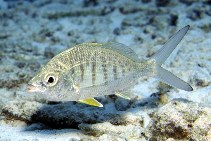
Anale stekels: 3; Anale zachte stralen: 7. Silvery with about seven faint pinkish bars on side on body; pelvic fins yellow (Ref. 13442).
Body shape (shape guide): fusiform / normal.
Inhabits shallow coastal waters in open sandy and surf areas, seagrass beds, near reefs, and mangrove channels (Ref. 7251). Enters brackish water, sometimes even fresh water (Ref. 3722). May occur in small aggregations (Ref. 3722). Feeds on benthic invertebrates such as worms, clams, crustaceans (Ref. 3722); also feeds on insects (Ref. 9303). Often seen feeding in sand patches among reefs by thrusting its mouth into the sediment and expelling sand from the gill openings (Ref. 13442). Easily approached (Ref. 9710). Marketed fresh but not highly esteemed; also processed into fishmeal (Ref. 3722).
Bussing, W.A., 1995. Gerreidae. Mojarras. p. 1114-1128. In W. Fischer, F. Krupp, W. Schneider, C. Sommer, K.E. Carpenter and V. Niem (eds.) Guia FAO para Identification de Especies para lo Fines de la Pesca. Pacifico Centro-Oriental. 3 Vols. FAO, Rome. (Ref. 9303)
Status op de Rode Lijst van het IUCN (Ref. 130435: Version 2025-2 (Global))
Gevaar voor de mens
Reports of ciguatera poisoning (Ref. 30911)
Gebruik door de mens
Visserij: van minder commercieel belang; sportvis: ja; aas: occasionally
Tools
Speciale rapporten
Download XML
Internetbronnen
Schattingen op basis van modellen
Gewenste temperatuur (Ref.
123201): 23.4 - 28.1, mean 27.3 °C (based on 792 cells).
Fylogenetische diversiteitsindex (Ref.
82804): PD
50 = 0.5000 [Uniqueness, from 0.5 = low to 2.0 = high].
Bayesian length-weight: a=0.01318 (0.01028 - 0.01691), b=3.04 (3.00 - 3.08), in cm total length, based on LWR estimates for this species (Ref.
93245).
Trofisch niveau (Ref.
69278): 3.5 ±0.2 se; based on diet studies.
Weerstandsvermogen (Ref.
120179): Gemiddeld, minimale populatieverdubbelingstijd 1,4-4,4 jaar (K=0.3-0.60; tm=1.5).
Kwetsbaarheid van de visserij (Ref.
59153): Low vulnerability (24 of 100).
🛈
Voedingsstoffen (Ref.
124155): Calcium = 38.3 [14.7, 84.5] mg/100g; Iron = 0.618 [0.273, 1.172] mg/100g; Protein = 20.5 [18.5, 22.5] %; Omega3 = 0.209 [0.106, 0.425] g/100g; Selenium = 12.5 [5.7, 26.9] μg/100g; VitaminA = 30.3 [7.2, 118.1] μg/100g; Zinc = 0.917 [0.561, 1.436] mg/100g (wet weight);