>
Eupercaria/misc (Various families in series Eupercaria) >
Labridae (Wrasses) > Hypsigenyinae
Etymology: Choerodon: Greek, choiros = a pig + odous = teeth (Ref. 45335); referrring to the prominent anterior canines of the species in this genus (Ref. 116605); zamboangae: Named for its type locality, Zamboanga, southern Philippines.
More on authors: Seale & Bean.
Umwelt: Milieu / Klimazone / Tiefenbereich / Verbreitungsgebiet
Ökologie
seewasser riff-verbunden; tiefenbereich 25 - 60 m (Ref. 90102). Tropical
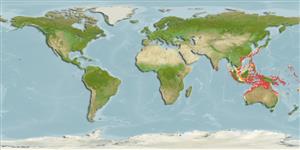
Indo-West Pacific: Philippines (Ref. 9710) to Indonesia and northwestern Australia. Possibly the male of Choerodon robustus (Ref. 9710).
Größe / Gewicht / Alter
Geschlechtsreife: Lm ? range ? - ? cm
Max length : 45.0 cm TL Männchen/unbestimmt; (Ref. 48636)
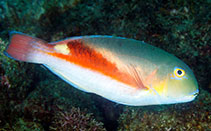
Rückenflossenstacheln (insgesamt) : 13; Rückenflossenweichstrahlen (insgesamt) : 7; Afterflossenstacheln: 3; Afterflossenweichstrahlen: 10. Body without a broad dark, pale-margined, oblique band on side; body bicoloured, dusky anterodorsally and pale posteroventrally, line of demarcation extending between base of first dorsal-fin spine and upper side of pectoral-fin base; a broad anteroventrally tapering reddish brown stripe covering dorsal half of side posterior to greenish brown anterodorsal portion of body; reddish brown area edged ventrally by yellow stripe. (Ref 9823)
Body shape (shape guide): fusiform / normal.
Found on deep outer reef habitats; flat sandy or weedy areas. Rarely seen by diving and is usually caught on lines from deep water (Ref. 48636). Usually found solitary, in rubble bottoms near seaward reefs. C. melanostigma is a junior synonym (Ref. 90102).
Lebenszyklus und Paarungsverhalten
Geschlechtsreife | Fortpflanzung | Ablaichen | Eier | Fruchtbarkeit | Larven
Oviparous, distinct pairing during breeding (Ref. 205).
Sainsbury, K.J., P.J. Kailola and G.G. Leyland, 1985. Continental shelf fishes of the northern and north-western Australia. An illustrated guide. CSIRO Division of Fisheries Research; Clouston & Hall and Peter Pownall Fisheries Information Service, Canberra, Australia. 375 p. (Ref. 3131)
IUCN Rote Liste Status (Ref. 130435: Version 2025-2 (Global))
Bedrohung für Menschen
Harmless
Nutzung durch Menschen
Tools
Zusatzinformationen
Download XML
Internet Quellen
Schätzungen auf der Grundlage von Modellen
Bevorzugte Temperatur (Ref.
123201): 24.2 - 28.4, mean 27.2 °C (based on 101 cells).
Phylogenetischer Diversitätsindex (Ref.
82804): PD
50 = 0.5000 [Uniqueness, from 0.5 = low to 2.0 = high].
Bayesian length-weight: a=0.00955 (0.00426 - 0.02142), b=3.10 (2.91 - 3.29), in cm total length, based on LWR estimates for this (Sub)family-body shape (Ref.
93245).
Trophische Ebene (Ref.
69278): 3.5 ±0.4 se; based on size and trophs of closest relatives
Widerstandsfähigkeit (Ref.
120179): mittel, Verdopplung der Population dauert 1,4 - 4,4 Jahre. (Preliminary K or Fecundity.).
Anfälligkeit der Fischerei (Ref.
59153): Low to moderate vulnerability (35 of 100).
🛈