>
Aulopiformes (Grinners) >
Synodontidae (Lizardfishes) > Synodontinae
Etymology: Synodus: Greek, syn, symphysis = grown together + Greek, odous = teeth (Ref. 45335).
Environnement : milieu / zone climatique / profondeur / gamme de distribution
Écologie
marin démersal; profondeur 88 - 232 m (Ref. 137548). Tropical
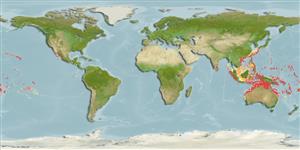
Eastern Central Pacific: Hawaii.
Taille / Poids / Âge
Maturité: Lm ? range ? - ? cm
Max length : 15.5 cm SL mâle / non sexé; (Ref. 137577)
Description synthétique
Clés d'identification | Morphologie | Morphométrie
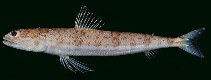
Rayons mous dorsaux (Total) : 10 - 13; Rayons mous anaux: 8 - 10; Vertèbres: 57 - 58. This species is distinguished by the following set of characters: D 10-13; A 8-10; lateral-line scales 56-60; scale rows above lateral line 3.5; vertebrae 57-58; anterior gill-rakers 25-36; pseudobranchial filaments 16-27; peritoneal spots 13-16; palatine teeth uniform in length and size; posterior part of preopercle scaled; anterior nostril flap (ANF) moderately long, slender,
triangular or leaf-shaped, does not or just reaching the rear margin of posterior nostril when laid back; ANF length/ inter-nostril distance (IND) 0.71-1.30 (mean 1.03); snout is moderately rounded in lateral view; pelvic fin moderately long, its length 22.8-27.2% in SL; posterior process of pelvic girdle wide. Colouration: when fresh, pale orange dorsally, white ventrally, with eight indistinct doughnut-shaped dark blotches along body axis, some continuous with saddle-shaped blotches on dorsum; pelvic-fin rays are white and fin membranes transparent, no additional markings; caudal fin uniform whitish, with white bands on upper lobe; color in alcohol pale, with scattered irregular dark pigmentation above the lateral line (Ref. 137548).
Body shape (shape guide): elongated; Cross section: circular.
Benthic at ca. 100 m (Ref. 58302).
Cycle de vie et comportement reproducteur
Maturité | Reproduction | Frai | Œufs | Fécondité | Larves
Furuhashi, R. and H. Motomura, 2025. A new species of Synodus from southern Japan, with a redescription of Synodus usitatus Cressey 1981 (Teleostei: Aulopiformes: Synodontidae). Ichthyol. Res. (2025):1-15. (Ref. 137548)
Statut dans la liste rouge de l'IUCN (Ref. 130435: Version 2025-2 (Global))
Menace pour l'homme
Harmless
Utilisations par l'homme
Outils
Articles particuliers
Télécharger en XML
Sources Internet
Estimations basées sur des modèles
Température préférée (Réf.
123201): 24.3 - 28.9, mean 27.6 °C (based on 686 cells).
Indice de diversité phylogénétique (Réf.
82804): PD
50 = 0.5000 [Uniqueness, from 0.5 = low to 2.0 = high].
Bayesian length-weight: a=0.00468 (0.00225 - 0.00972), b=3.15 (2.98 - 3.32), in cm total length, based on LWR estimates for this Genus-body shape (Ref.
93245).
Niveau trophique (Réf.
69278): 4.0 ±0.7 se; based on size and trophs of closest relatives
Résilience (Réf.
120179): Haut, temps minimum de doublement de population inférieur à 15 mois (Preliminary K or Fecundity.).
Vulnérabilité de la pêche (Ref.
59153): Low vulnerability (10 of 100).
🛈