Umwelt: Milieu / Klimazone / Tiefenbereich / Verbreitungsgebiet
Ökologie
seewasser demersal. Tropical
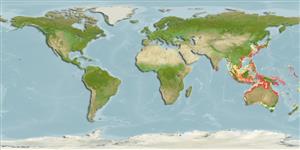
Eastern Indian Ocean to Western Pacific: Australia and Indonesia.
Größe / Gewicht / Alter
Geschlechtsreife: Lm ? range ? - ? cm
Max length : 45.0 cm TL Männchen/unbestimmt; (Ref. 3132); max. veröff. Gewicht: 5.0 kg (Ref. 3132)
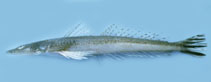
This species is distinguished by the following characters: a single small isolated dorsal spine anteriorly; second dorsal and anal fin rays usually 13; snout long, 28.5-31.0% HL; larger specimens with interorbit narrow 7.7-12.0% HL; postorbital short, 50.7-56.4% HL; posterior portion of snout and interorbital covered with scales; upper iris lappet triangular; skinny sensory tubes from the suborbital bones and preopercle not covering the cheek region; preopercule with 2 spines, the lower slightly longer than the upper; fingerlike interopercular flap; a single exterior opening of the lateral line scales; head and body pale brown, with many small brownish spots dorsally, 4 or more dark longitudinal bands on caudal fin, and upper lobe of caudal fin lacking yellow blotch when fresh (Ref. 86914).
Found on sand bottoms (Ref. 3132). Neither anterolateral glandular groove nor venom gland is present (Ref. 57406).
Lebenszyklus und Paarungsverhalten
Geschlechtsreife | Fortpflanzung | Ablaichen | Eier | Fruchtbarkeit | Larven
Imamura, H., 2008. Synonymy of two species of the genus Platycephalus and validity of Platycephalus westraliae (Teleostei: Platycephalidae). Ichthyol. Res. 55:399-406. (Ref. 86914)
IUCN Rote Liste Status (Ref. 130435: Version 2025-2 (Global))
Nutzung durch Menschen
Tools
Zusatzinformationen
Download XML
Internet Quellen
Schätzungen auf der Grundlage von Modellen
Bevorzugte Temperatur (Ref.
123201): 21.5 - 28.8, mean 27.7 °C (based on 528 cells).
Phylogenetischer Diversitätsindex (Ref.
82804): PD
50 = 0.5000 [Uniqueness, from 0.5 = low to 2.0 = high].
Bayesian length-weight: a=0.00427 (0.00219 - 0.00832), b=3.11 (2.94 - 3.28), in cm total length, based on LWR estimates for this (Sub)family-body shape (Ref.
93245).
Trophische Ebene (Ref.
69278): 4.4 ±0.7 se; based on diet studies.
Widerstandsfähigkeit (Ref.
120179): mittel, Verdopplung der Population dauert 1,4 - 4,4 Jahre. (Preliminary K or Fecundity.).
Anfälligkeit der Fischerei (Ref.
59153): Low to moderate vulnerability (35 of 100).
🛈
Nährstoffe (Ref.
124155): Calcium = 222 [25, 1,177] mg/100g; Iron = 2.22 [0.59, 6.27] mg/100g; Protein = 17.1 [14.7, 19.4] %; Omega3 = 0.24 [0.10, 0.72] g/100g; Selenium = 116 [27, 511] μg/100g; VitaminA = 33.6 [12.1, 93.2] μg/100g; Zinc = 1.08 [0.47, 2.35] mg/100g (wet weight);