>
Tetraodontiformes (Puffers and filefishes) >
Monacanthidae (Filefishes)
Etymology: Cantherhines: Greek, kanthos = the outer or inner corner of the eye, where the lids meet, 1646 + Greek, rhinos = nose (Ref. 45335).
Lingkungan: lingkungan / zona iklim / kisaran kedalaman / jangkauan distribusi
Ekologi
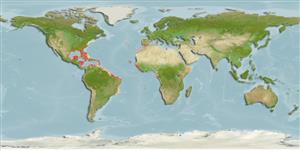
laut berasosiasi dengan karang; kisaran kedalaman 3 - 50 m (Ref. 3592), usually 3 - 20 m (Ref. 40849). Subtropical; 42°N - 26°S, 98°W - 10°E
Western Atlantic: Massachusetts (USA), Bermuda, and northern Gulf of Mexico to southeastern Brazil. Eastern Atlantic: São Tomé, Gulf of Guinea (Ref. 3592).
Ukuran / Berat / umur
Kematangan: Lm ? range ? - ? cm
Max length : 20.0 cm TL jantan/; (Ref. 7251); common length : 14.0 cm TL jantan/; (Ref. 3592)
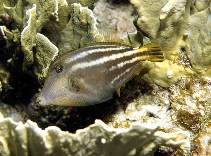
Duri punggung (Keseluruhan (total)) : 2; duri punggung lunak (Keseluruhan (total)) : 33 - 36; Duri dubur: 0; Sirip dubur lunak: 29 - 32. First dorsal spine originating over center or front part of eye and followed by a deep groove into which the spine can fold; body with small scattered orange spots, many of which have brown centers, and whitish spots of same size; dull yellow lines on head which run towards snout, those near eye alternating with bluish lines (Ref. 13442).
Body shape (shape guide): short and / or deep.
Found in shallow water and around coral and rocky reefs (Ref. 3790). Usually remains near the bottom, hiding among gorgonians and branching coral (Ref. 9710). Feeds on bottom growth, primarily sponge and algae, but stomach often contain tunicates, bryozoans and other sessile benthic invertebrates (Ref. 5521). The young are pelagic and highly important food items in the diet of large predaceous fishes such as tunas and billfishes (Ref. 3790). Generally considered as trash fish, rarely consumed (Ref. 3790).
Siklus hidup dan perilaku kawin
Kematangan | Reproduksi, perkembang biakan | Pemijahan | telur-telur | Fekunditas | Larva
Robins, C.R. and G.C. Ray, 1986. A field guide to Atlantic coast fishes of North America. Houghton Mifflin Company, Boston, U.S.A. 354 p. (Ref. 7251)
Status IUCN Red List (Ref. 130435: Version 2025-2 (Global))
ancaman kepada manusia
Reports of ciguatera poisoning (Ref. 30303)
penggunaan manusia
Perikanan: perikanan swasembada; Akuarium: Komersial
Alat, peralatan
laporan khas
muat turun XML
Sumber internet
Estimasi berdasarkan model
Suhu yang disukai (Acuan
123201): 23.4 - 28, mean 26.4 °C (based on 402 cells).
Indeks keanekaragaman filogenetik (Acuan
82804): PD
50 = 0.5002 [Uniqueness, from 0.5 = low to 2.0 = high].
Bayesian length-weight: a=0.02138 (0.01227 - 0.03725), b=2.89 (2.74 - 3.04), in cm total length, based on LWR estimates for this species & (Sub)family-body (Ref.
93245).
Tingkat Trofik (Acuan
69278): 2.6 ±0.1 se; based on diet studies.
Daya lenting (Acuan
120179): Tinggi, Waktu penggandaan populasi minimum kurang dari 15 bulan (Preliminary K or Fecundity.).
Kerentanan Penangkapan Ikan (Ref.
59153): Low vulnerability (10 of 100).
🛈
Nutrisi (Ref.
124155): Calcium = 26.9 [4.9, 86.5] mg/100g; Iron = 0.924 [0.313, 2.627] mg/100g; Protein = 18.6 [16.3, 20.8] %; Omega3 = 0.125 [0.057, 0.285] g/100g; Selenium = 20.4 [7.1, 61.8] μg/100g; VitaminA = 37.8 [8.8, 168.8] μg/100g; Zinc = 1.4 [0.6, 2.5] mg/100g (wet weight);