>
Osteoglossiformes (Bony tongues) >
Mormyridae (Elephantfishes)
Etymology: Petrocephalus: Latin, petra = stone + Greek, kephale = head (Ref. 45335).
Eponymy: Dr Noel Eugene Balay (1847–1902) was a French explorer and colonial administrator. [...] (Ref. 128868), visit book page.
More on author: Sauvage.
Umwelt: Milieu / Klimazone / Tiefenbereich / Verbreitungsgebiet
Ökologie
; süßwasser demersal. Tropical
Africa: Ogowe River in Gabon (Ref. 3203, 85311) and Congo River basin in Cameroon (Ref. 46901), Republic of Congo (Ref. 85311) and Democratic Republic of the Congo (Ref. 1879, 4910, 41580, 41590, 44985, 45434, 45441, 93897, 106245).
Größe / Gewicht / Alter
Geschlechtsreife: Lm ? range ? - ? cm
Max length : 11.0 cm TL Männchen/unbestimmt; (Ref. 42522)
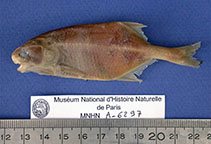
Petrocephalus balayi is distinguished from all other Petrocephalus species in Central Africa by the following combination of characteristics: dorsal fin with 20-22 branched rays, anal fin with 26 or 27 branched rays, eye small (HL/ED=4,5-4,9), mouth very wide, associated with a very characteristic head shape when viewed from below, 14 teeth or more in the upper jaw, 28 teeth or more in the lower jaw (Ref. 85331). Melanin pattern consisting of the following: (1) a distinct black round mark on each side of the body below dorsal fin origin; (2) an ovoid mark on each side at the base of the caudal peduncle, not extending onto the upper and lower parts of the caudal fin; (3) a black mark, sometimes diffuse but always present, at the base of the pectoral fins (Ref. 85331).
Body shape (shape guide): fusiform / normal.
Lebenszyklus und Paarungsverhalten
Geschlechtsreife | Fortpflanzung | Ablaichen | Eier | Fruchtbarkeit | Larven
Gosse, J.-P., 1984. Mormyridae. p. 63-122. In J. Daget, J.-P. Gosse and D.F.E. Thys van den Audenaerde (eds.) Check-list of the freshwater fishes of Africa (CLOFFA). ORSTOM, Paris and MRAC, Tervuren. Vol. 1. (Ref. 3203)
IUCN Rote Liste Status (Ref. 130435: Version 2025-2 (Global))
Bedrohung für Menschen
Harmless
Nutzung durch Menschen
Tools
Zusatzinformationen
Download XML
Internet Quellen
Schätzungen auf der Grundlage von Modellen
Phylogenetischer Diversitätsindex (Ref.
82804): PD
50 = 0.5000 [Uniqueness, from 0.5 = low to 2.0 = high].
Bayesian length-weight: a=0.01585 (0.00843 - 0.02981), b=2.96 (2.80 - 3.12), in cm total length, based on LWR estimates for this species & Genus-body shape (Ref.
93245).
Trophische Ebene (Ref.
69278): 3.2 ±0.4 se; based on size and trophs of closest relatives
Widerstandsfähigkeit (Ref.
120179): hoch, Verdopplung der Population dauert weniger als 15 Monate. (Preliminary K or Fecundity.).
Anfälligkeit der Fischerei (Ref.
59153): Low vulnerability (10 of 100).
🛈