>
Gonorynchiformes (Milkfishes) >
Kneriidae (Shellears)
Etymology: fortuita: Name reflects a number of fortuitous circumstances that were involved in collecting this species; camp was made at sunset at river under the impression it was the Okavango, when next morning the error was discovered it was impossible to go on to the Okavango as the Cutato bridge was burnt down and heavy rain had closed the alternate route, leaving this the only place to work that day; also October 13 1972 was a Friday (Ref. 86888).
Eponymy: This is not an eponym, but an interesting name nonetheless. [...] (Ref. 128868), visit book page.
Ambiente: milieu / zona climatica / distribuzione batimetrica / gamma di distribuzione
Ecologia
; acqua dolce benthopelagico. Tropical; 13°S - 15°S
Dimensione / Peso / Età
Maturità: Lm ? range ? - ? cm
Max length : 6.7 cm SL maschio/sesso non determinato; (Ref. 137577)
Breve descrizione
Chiavi di identificazione | Morfologia | Morfometria
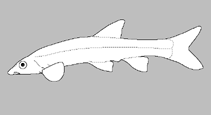
Spine dorsali (totale) : 0; Raggi dorsali molli (totale) : 11; Spine anali: 0; Raggi anali molli: 8; Vertebre: 43. Diagnosis: elongate, small species, body depth 6.4-8.0 times in SL; body width 8.2-10.0 times in SL; head rather short, 4.9-5.5 times in SL, about twice as long as broad (Ref. 86888). Head smooth, round in front, flat below (Ref. 52193). Eye laterodorsal (Ref. 86888), about 4.1-5 times in HL, 0.9-1.3 times in interorbital distance and 1.6-2.1 times in snout length (Ref. 89112), its horizontal diameter slightly less than interorbital distance; snout length equal to postorbital distance; interorbital distance about equal to mouth width; jaws without teeth, but with horny edges to jaws (Ref. 86888). Mouth straight, tadpole-like; gill openings form a slit above pectoral fins (Ref. 52193). Dorsal fin origin very slightly anterior to pelvic fin origin, slightly posterior to midpoint of SL (Ref. 86888), nearer to origin of caudal fin than to snout (Ref. 52193). Anal fin well posterior (Ref. 86888), closer to caudal fin origin than pelvic fin origin (Ref. 52193, 86888). Anal fin membrane relatively thick; pectoral fin large and ventral, its length 0.9 times in HL, 6.0 times in SL; pelvic fin 1.3 times in pectoral, 8.1 times in SL; strip of belly between pectoral and pelvic fins appears naked but has fine transparent scales; top, bottom and sides of head naked (Ref. 86888).
Body shape (shape guide): elongated; Cross section: circular.
Lives among rocks in flowing water; feeds off diatoms and other algae and detritus scraped from rock surfaces (Ref. 7248, 52193).
Ciclo vitale e comportamento di accoppiamento
Maturità | Riproduzione | Deposizione | Uova | Fecondità | Larve
Poll, M., 1984. Kneriidae. p. 129-133. In J. Daget, J.-P. Gosse and D.F.E. Thys van den Audenaerde (eds.) Check-list of the freshwater fishes of Africa (CLOFFA). ORSTOM, Paris and MRAC, Tervuren. Vol. 1. (Ref. 3565)
Stato della Lista Rossa IUCN (Ref. 130435: Version 2025-2 (Global))
Minaccia per l'uomo
Harmless
Usi umani
Strumenti
Rapporti speciali
Scarica XML
Fonti Internet
Stime basate su modelli
Indice di diversità filogenetica (Fonte Biblio.
82804): PD
50 = 0.5000 [Uniqueness, from 0.5 = low to 2.0 = high].
Bayesian length-weight: a=0.00389 (0.00180 - 0.00842), b=3.12 (2.94 - 3.30), in cm total length, based on all LWR estimates for this body shape (Ref.
93245).
Livello trofico (Fonte Biblio.
69278): 2.0 ±0.00 se; based on food items.
Vulnerabilità della pesca (Ref.
59153): Low vulnerability (10 of 100).
🛈