>
Gonorynchiformes (Milkfishes) >
Kneriidae (Shellears)
Etymology: Grasseichthys: Greek, grassos, -ou = stink, dirt + Greek, ichthys = fish (Ref. 45335).
Eponymy: Dr Pierre-Paul Grassé (1895–1985) was a French entomologist and biologist. [...] (Ref. 128868), visit book page.
More on author: Géry.
Environnement : milieu / zone climatique / profondeur / gamme de distribution
Écologie
; eau douce benthopélagique. Tropical
Africa: scattered localities in the Ivindo and the larger Ogowe basin of Gabon; reports from the central Congo basin refer to another species (Ref. 81636).
Taille / Poids / Âge
Maturité: Lm ? range ? - ? cm
Max length : 2.1 cm SL mâle / non sexé; (Ref. 42473)
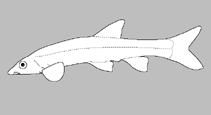
Épines dorsales (Total) : 0; Rayons mous dorsaux (Total) : 7 - 8; Épines anales: 0; Rayons mous anaux: 9 - 10; Vertèbres: 35 - 36. Diagnosis: very small and larval in appearance; body elongate, laterally compressed, shallow (body depth 17.9-20.0% SL in females and 15.2-17.9% SL in males); scaleless; head small (head length 18.0-22.7% SL), with small, terminal mouth and large eyes; teeth absent; interorbital distance narrow (11.9-12.9% HL); gill opening short and located above pectoral fin; pectoral fins positioned ventrally and often splayed out from the body in preserved specimens; caudal peduncle long, with keels of transparent tissue, apparently anterior extensions of caudal fin membrane, reaching forward on both dorsal and ventral edge (ventral extension is more developed); caudal fin forked, with 16 rays, including an unbranched ray on dorsal and ventral edge; fin spines lacking; 2 branchiostegal rays; body semi-translucent, with myomeres clearly visible; lateral line absent; epibranchial organ reduced or absent (Ref. 81636).
Body shape (shape guide): elongated.
Open water species, not burrying in sand; forms schools; spawns during the raining season, during which it may be very abundant, forming aggregations in open water areas in the swamps; females of 20-24mm carry about 40 round, ripe eggs of about 0.4mm diameter; males mature at a size of about 18mm total length (Ref. 91379).
Cycle de vie et comportement reproducteur
Maturité | Reproduction | Frai | Œufs | Fécondité | Larves
Géry, J., 1965. Poissons du bassin de l'Ivindo. I - Les biotopes. Biol. Gabon. 1(4):375-384. (Ref. 91379)
Statut dans la liste rouge de l'IUCN (Ref. 130435: Version 2025-2 (Global))
Menace pour l'homme
Harmless
Utilisations par l'homme
Outils
Articles particuliers
Télécharger en XML
Sources Internet
Estimations basées sur des modèles
Indice de diversité phylogénétique (Réf.
82804): PD
50 = 0.7500 [Uniqueness, from 0.5 = low to 2.0 = high].
Bayesian length-weight: a=0.00389 (0.00180 - 0.00842), b=3.12 (2.94 - 3.30), in cm total length, based on all LWR estimates for this body shape (Ref.
93245).
Vulnérabilité de la pêche (Ref.
59153): Low vulnerability (10 of 100).
🛈