Taxonomic Remarks
See explanation of name change from Distichodus niloticus (Hasselquist, 1762) in Eschmeyer (CofF ver. Oct. 2012: Ref. 92135) according to Fricke (2008: Ref. 83466).
Meio ambiente: milieu / Zona climática / intervalo de profundidade / faixa de distribuição
Ecologia
; Água doce pelágico(a,os,as). Tropical
Africa: Lake Albert (Ref. 4903, 49805), Lakes Turkana and No, Murchison Nile (Ref. 4903), White and Blue Nile, and the Chad basin where it is uncommon (Ref. 7094).
Tamanho / Peso / Idade
Maturidade: Lm ? range ? - ? cm
Max length : 83.0 cm TL macho/indeterminado; (Ref. 7094); peso máx. publicado: 6.2 kg (Ref. 7094)
Descrição suscinta
Chaves de identificação | Morfologia | Morfometria
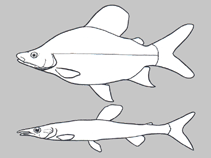
Raios dorsais (total) : 22 - 26; Raios anais : 13 - 15. Diagnosis: depth of body 2.5-3.5 times in standard length, length of head 3 (in young fishes) to 5 times (in adults) (Ref. 4903). Snout not elongated (Ref. 28714), rounded (Ref. 4903), not or slightly projecting beyond the mouth (Ref. 4903, 28714). Maxilla extending to below the nostrils; upper surface of the head, and the operculum ridged with low, radiating striations (Ref. 4903). Teeth all small and bicuspidate (Ref. 28714), in two series, outer with 24-36 teeth (Ref. 4903). Dorsal fin with 22-26 rays, the first 3-6 unbranched (Ref. 4903). Adipose fin covered with small scales (Ref. 4903, 28714), small, its basal length about 2-4 times its distance from the posterior margin of the dorsal fin (Ref. 28714). Anal fin with 13-15 rays, the first 3-4 unbranched; caudal fin forked, its rounded lobes almost entirely scaled; lateral line with 90-110 scales (Ref. 4903). 18-21 scales between lateral line and dorsal-fin origin (Ref. 4903, 28714). 15-18 scales between insertion of pelvic fin and lateral line (Ref. 4903). Large robust fish as adults (Ref. 28714).
Coloration: purplish-silver above, silver below; young fishes with several vertical dark bars on the flank (Ref. 4903).
In Lake Albert found in the shallow inshore waters, especially in the region of
deltas; also in rivers (Ref. 4903). Macro-herbivore, feeds on submerged water plants (Ref. 4903, 28714), Eichornia roots and periphyton (Ref. 28714), but also molluscs and small Crustacea (Ref. 4903). Oviparous (Ref. 205).
Ciclo de vida ou comportamento de acasalamento
Maturidade | Reprodução | Desova | Ovos | Fecundidade | Larvas
Oviparous (Ref. 205). Distinct pairing occurs (Ref. 205). Males lingering near the nesting site deemed as the closest thing to parental care (Ref. 205).
Daget, J. and J.-P. Gosse, 1984. Distichodontidae. p. 184-211. In J. Daget, J.-P. Gosse and D.F.E. Thys van den Audenaerde (eds.) Check-list of the freshwater fishes of Africa (CLOFFA). ORSTOM, Paris and MRAC, Tervuren. Vol. 1. (Ref. 7094)
Status na Lista Vermelha da UICN (Ref. 130435: Version 2025-2 (Global))
Ameaça para os humanos
Harmless
Uso pelos humanos
Ferramentas
Relatórios especiais
Baixar XML
Fontes da internet
Estimativas baseadas em modelos
Índice de diversidade filogenética (Ref.
82804): PD
50 = 0.5000 [Uniqueness, from 0.5 = low to 2.0 = high].
Bayesian length-weight: a=0.00447 (0.00186 - 0.01072), b=3.17 (2.97 - 3.37), in cm total length, based on LWR estimates for this (Sub)family-body shape (Ref.
93245).
Nível Trófico (Ref.
69278): 2.0 ±0.00 se; based on food items.
Vulnerabilidade da pesca (Ref.
59153): Moderate to high vulnerability (53 of 100).
🛈