Lingkungan: lingkungan / zona iklim / kisaran kedalaman / jangkauan distribusi
Ekologi
; air tawar pelagis, permukaan. Tropical
Africa: widespread throughout Lower and Central Congo River basin in Democratic Republic of the Congo, Republic of Congo, Central African Republic and Angola (Ref. 96324, 122092), including Ubangui, Sangha and lower Kasai River systems (Ref. 122092). It has only been found in one locality in the Upper Congo, at Kabalo on the Lualaba River (Ref. 51906, 122092).
Ukuran / Berat / umur
Kematangan: Lm ? range ? - ? cm
Max length : 35.7 cm SL jantan/; (Ref. 122092)
deskripsi pendek
Kunci identifiaksi (pengenalan) | Morfologi | Morfometrik
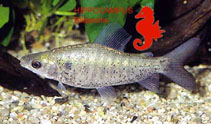
Duri punggung (Keseluruhan (total)) : 0; duri punggung lunak (Keseluruhan (total)) : 22 - 24; Duri dubur: 0; Sirip dubur lunak: 13 - 14. Diagnosis: Distichodus atroventralis is distinguished from D. affinis, D. altus, D. decemmaculatus, D. noboli, D. notospilus and D. teugelsi by the higher number of lateral line scales, 61-71 vs. 37-46; from D. antonii by the inferior mouth vs. terminal, and a lower number of dark vertical bars, 6-9 vs. 9-14; from D. fasciolatus by the higher number of pelvic-fin rays, 11, exceptionally 10, vs. 10, exceptionally 11, the lower number of dark vertical bars, at least in specimens smaller than about 150 mm standard length, 6-9 vs. 13-20, and the blackish pelvic fin, at least in specimens smaller than about 200 mm standard length vs. whitish-yellow; from D. langi by fewer dorsal-fin rays, 22-24 vs. 26-28, a lower number of pectoral-fin rays, 17-20 vs. 21, a shallower head, 35-53% of head length vs. 67-69, and fewer dark vertical bars, 6-8 vs. 13; from D. lusosso by the inferior mouth vs. terminal, and the short snout vs. elongated; from D. maculatus by the absence of dark blotches all over the body vs. dark blotches all over the body; and from D. sexfasciatus by the higher number of teeth in the outer row of the upper and lower jaw, 18-36 and 20-34 vs. 12-14 on both jaws, and the greenish to light brown and yellowish body colouration vs. orange-reddish (Ref. 122092). It is distinguished from its most similar congener, D. kasaiensis, by having fewer dorsal-fin rays, 22-24 vs. 27-29, more teeth in the upper jaw, 18-36 vs. 15-25 (overlap due to positive allometry), and by having a shorter dorsal-fin base, 20.1-28.8% of standard length vs. 24.9-33.7% (overlap due to positive allometry); and from D. ingae by having fewer dorsal-fin rays, 22-24 vs. 26, and shorter dorsal fin, 12.0-21.9% of standard length vs. 23.6-24.2%, anal fin, 9.9-15.7% of standard length vs. 16.9-17.5%, and pectoral fin, 14.2-20.5% of standard length vs. 21.6-22.7% (Ref. 122092).
Body shape (shape guide): short and / or deep; Cross section: compressed.
Siklus hidup dan perilaku kawin
Kematangan | Reproduksi, perkembang biakan | Pemijahan | telur-telur | Fekunditas | Larva
Moelants, T., J. Snoeks and E. Vreven, 2018. Distichodus kasaiensis and D. ingae, two new distichodontid species (Characiformes: Distichodontidae) from the Congo basin. Ichthyol. Explor. Freshwat. 28(2):177-192. (Ref. 122092)
Status IUCN Red List (Ref. 130435: Version 2025-2 (Global))
ancaman kepada manusia
Harmless
penggunaan manusia
Alat, peralatan
laporan khas
muat turun XML
Sumber internet
Estimasi berdasarkan model
Indeks keanekaragaman filogenetik (Acuan
82804): PD
50 = 0.5000 [Uniqueness, from 0.5 = low to 2.0 = high].
Bayesian length-weight: a=0.01445 (0.00602 - 0.03469), b=3.05 (2.86 - 3.24), in cm total length, based on LWR estimates for this Genus-body shape (Ref.
93245).
Kerentanan Penangkapan Ikan (Ref.
59153): Low to moderate vulnerability (34 of 100).
🛈