Klassifizierung / Names
Namen | Synonyme | Catalog of Fishes(Gattung, Arten) | ITIS | CoL | WoRMS | Cloffa
Umwelt: Milieu / Klimazone / Tiefenbereich / Verbreitungsgebiet
Ökologie
; süßwasser benthopelagisch; potamodrom (Ref. 138143); tiefenbereich 0 - 50 m (Ref. 34291). Tropical
Africa: known from the Middle Akagera (Ref. 27626), Rusizi River, Lake Kivu, Lake Edward, Lake George, Lake Victoria and Lake Kyoga drainages, and northern part of Lake Tanganyika (Ref. 27626, 107916).
Länge bei der ersten Reifung / Größe / Gewicht / Alter
Geschlechtsreife: Lm 54.0 range ? - ? cm
Max length : 90.0 cm TL Männchen/unbestimmt; (Ref. 27626)
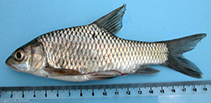
Rückenflossenstacheln (insgesamt) : 3; Rückenflossenweichstrahlen (insgesamt) : 9 - 11; Afterflossenstacheln: 2 - 3; Afterflossenweichstrahlen: 5 - 6. The anterior barbel reaches the middle of the eye but in general, it is very short, not reaching the anterior side of the eye; the posterior barbel always reaches beyond the anterior eye, sometimes including the anterior side of the operculae; lips well-developed. Sometimes, an outgrowth is present on the snout (Ref. 27626).
Body shape (shape guide): fusiform / normal.
In Lake Victoria drainage: adults are found in inshore waters and affluent rivers (Ref. 4903, 34290). Young occur in shoals (Ref. 36900) in riverine habitats while adults occur in both riverine and lacustrine habitats (Ref. 34291). Mature individuals swim upstream to spawn (Refs. 36900, 87863), probably in swift, rocky upper reaches of rivers (Ref. 34291). Food consists of gastropod molluscs, insects, plants, fishes and crustacea (Ref. 12526). In lakes Edward and George: in shallow water (Ref. 4903). Oviparous (Ref. 205). A food fish for humans (Ref. 4537), but not of great economic importance (Ref. 4903).
Lebenszyklus und Paarungsverhalten
Geschlechtsreife | Fortpflanzung | Ablaichen | Eier | Fruchtbarkeit | Larven
De Vos, L. and D.F.E. Thys van den Audenaerde, 1990. Description de Barbus claudinae sp. n. (Cyprinidae) avec synopsis des grandes espèces de Barbus du Rwanda. Cybium 14(1):3-25. (Ref. 27626)
IUCN Rote Liste Status (Ref. 130435: Version 2025-2 (Global))
Bedrohung für Menschen
Harmless
Nutzung durch Menschen
Fischereien: kleinfischerei; Sportfisch: ja
Tools
Zusatzinformationen
Download XML
Internet Quellen
Schätzungen auf der Grundlage von Modellen
Phylogenetischer Diversitätsindex (Ref.
82804): PD
50 = 0.5000 [Uniqueness, from 0.5 = low to 2.0 = high].
Bayesian length-weight: a=0.01023 (0.00506 - 0.02069), b=3.04 (2.87 - 3.21), in cm total length, based on LWR estimates for this species & (Sub)family-body (Ref.
93245).
Trophische Ebene (Ref.
69278): 3.4 ±0.52 se; based on food items.
Widerstandsfähigkeit (Ref.
120179): niedrig, Verdopplung der Population dauert 4,5 - 14 Jahre. (Preliminary K or Fecundity.).
Anfälligkeit der Fischerei (Ref.
59153): High vulnerability (56 of 100).
🛈
Nährstoffe (Ref.
124155): Calcium = 85.5 [50.9, 150.4] mg/100g; Iron = 1.19 [0.78, 1.82] mg/100g; Protein = 17.6 [16.8, 18.5] %; Omega3 = 0.468 [0.199, 1.100] g/100g; Selenium = 97.1 [41.6, 211.3] μg/100g; VitaminA = 52.5 [20.3, 128.2] μg/100g; Zinc = 1.46 [1.07, 2.05] mg/100g (wet weight);