>
Cypriniformes (Carps) >
Cyprinidae (Minnows or carps) > Smiliogastrinae
Etymology: Enteromius: Greek, enteron = intestine + Greek, myo, mys = muscle (Ref. 45335).
More on author: Boulenger.
Environnement : milieu / zone climatique / profondeur / gamme de distribution
Écologie
; eau douce benthopélagique; pH range: 6.0 - 6.5; dH range: 12 - ?. Tropical; 23°C - 26°C (Ref. 2059)
Africa: widely distributed, in Aswa River, Lake Victoria basin including affluent rivers and Akagera system, Lake Edward-George system, Lake Kivu basin, Lake Tanganyika (Ref. 27628), Rusizi River, Malagarazi River (Ref. 98755) and Lake Rukwa drainage (Ref. 27292). Also in coastal river basins in Kenya (Ref. 52331) and Tanzania (Ref. 4967), in the lower Lukuga River (upper Congo River basin) (Ref. 93587) and in the Ennedi Plateau of Chad (Ref. 26830, 27628).
Longueur à la première maturité / Taille / Poids / Âge
Maturité: Lm ?, range 4 - ? cm
Max length : 5.4 cm SL mâle / non sexé; (Ref. 27628)
Description synthétique
Clés d'identification | Morphologie | Morphométrie
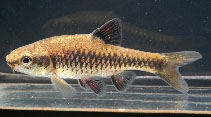
Rayons mous dorsaux (Total) : 7 - 8; Rayons mous anaux: 5. Last unbranched ray of dorsal fin thorny and with denticulated posterior side; one barbel on each side of the mouth (Ref. 27628). Dorsal side of body brown-green colored, ventral side silver with grayish spots in the center of the scales; dorsal, anal and pelvic fins are grayish or blackish with a reddish or green-brown zone in the center, caudal fin is yellow-brown or yellow-green; mostly with a black spot on the base of caudal fin and anal fin (Ref. 27528).
Body shape (shape guide): elongated.
Occurs in temporary and permanent streams as well as in marginal water-lily swamps in Lake Victoria basin (Ref. 104790). Found in pools near papyrus vegetation (Ref. 9606) and in smaller bodies of water or near the margins of rivers between the vegetation in the Lake Rukwa drainage (Ref. 27292). Feeds on insect larvae (Ref. 4903). Spawns in temporary streams when flooded during rainy season (Ref. 104790) and spawns all year round with maximum at beginning of rainy season (Ref. 27292).
Cycle de vie et comportement reproducteur
Maturité | Reproduction | Frai | Œufs | Fécondité | Larves
Lévêque, C. and J. Daget, 1984. Cyprinidae. p. 217-342. In J. Daget, J.-P. Gosse and D.F.E. Thys van den Audenaerde (eds.) Check-list of the freshwater fishes of Africa (CLOFFA). ORSTOM, Paris and MRAC, Tervuren. Vol. 1. (Ref. 2801)
Statut dans la liste rouge de l'IUCN (Ref. 130435: Version 2025-2 (Global))
Menace pour l'homme
Harmless
Utilisations par l'homme
Pêcheries: sans intérêt
Outils
Articles particuliers
Télécharger en XML
Sources Internet
Estimations basées sur des modèles
Indice de diversité phylogénétique (Réf.
82804): PD
50 = 0.5000 [Uniqueness, from 0.5 = low to 2.0 = high].
Bayesian length-weight: a=0.00603 (0.00282 - 0.01286), b=3.06 (2.87 - 3.25), in cm total length, based on LWR estimates for this (Sub)family-body shape (Ref.
93245).
Niveau trophique (Réf.
69278): 2.9 ±0.32 se; based on food items.
Résilience (Réf.
120179): Haut, temps minimum de doublement de population inférieur à 15 mois (tm=1).
Vulnérabilité de la pêche (Ref.
59153): Low vulnerability (10 of 100).
🛈