>
Eupercaria/misc (Various families in series Eupercaria) >
Haemulidae (Grunts) > Haemulinae
Etymology: Brachygenys: Name from Greek βραχυζ (Brachy), short and ϒενυζ (genys), chin; referring to the small snout of the these species.
More on author: Günther.
Milieu: milieu / Klimaatzone / Diepte / verspreidingsgebied
Ecologie
marien rifbewoner; diepte 0 - 25 m (Ref. 7251). Subtropical; 32°N - 34°S, 98°W - 34°W
Western Atlantic: southern Florida (USA) to Brazil including the Antilles.
Grootte / Gewicht / Leeftijd
Maturiteit: Lm ? range ? - ? cm
Max length : 23.0 cm TL mannelijk / geslacht onbekend; (Ref. 7251); common length : 17.0 cm TL mannelijk / geslacht onbekend; (Ref. 3798)
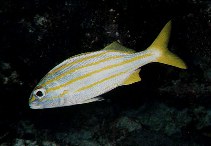
Dorsale stekels (totaal) : 12; Dorsale zachte stralen (totaal) : 13; Anale stekels: 3; Anale zachte stralen: 9 - 10. 6 straight, even, and nearly equally wide bronze-yellow stripes on side (Ref. 26938). Snout short, mouth nearly horizontal and small, the maxilla usually not reaching a vertical at front edge of pupil; fins largely yellow (Ref. 13442).
Body shape (shape guide): fusiform / normal.
Inhabits exposed rocky areas and coral reefs. Often near elkhorn and staghorn corals (Ref. 9710). Commonly found in schools. Juveniles are encountered in Thalassia beds (Ref. 9626). Adults are observed in coral reefs during the day but enters open waters at night to feed on mainly on plankton (Ref. 9626), but also on small crustaceans and mollusks. Marketed fresh (Ref. 3798).
Levenscyclus en paargedrag
Maturiteit | Voortplanting | Paaien | Eieren | Fecunditeit | Larven
Oviparous, distinct pairing during breeding (Ref. 205).
Tavera, J., A. Acero P. and P.C. Wainwright, 2018. Multilocus phylogeny, divergence times, and a major role for the benthic-topelagic axis in the diversification of grunts (Haemulidae). Molecular Phylogenetics and Evolution 121(2018):212-223. (Ref. 125434)
Status op de Rode Lijst van het IUCN (Ref. 130435: Version 2025-2 (Global))
Gevaar voor de mens
Harmless
Gebruik door de mens
Visserij: van minder commercieel belang; Aquarium: Publieke aquaria; aas: usually
Tools
Speciale rapporten
Download XML
Internetbronnen
Schattingen op basis van modellen
Gewenste temperatuur (Ref.
123201): 26.3 - 28.2, mean 27.4 °C (based on 634 cells).
Fylogenetische diversiteitsindex (Ref.
82804): PD
50 = 0.5625 [Uniqueness, from 0.5 = low to 2.0 = high].
Bayesian length-weight: a=0.01230 (0.00749 - 0.02021), b=2.99 (2.85 - 3.13), in cm total length, based on LWR estimates for this species & (Sub)family-body (Ref.
93245).
Trofisch niveau (Ref.
69278): 3.5 ±0.2 se; based on diet studies.
Weerstandsvermogen (Ref.
120179): Hoog, minimale populatieverdubbelingstijd minder dan 15 maanden (Preliminary K or Fecundity.).
Kwetsbaarheid van de visserij (Ref.
59153): Low vulnerability (13 of 100).
🛈
Voedingsstoffen (Ref.
124155): Calcium = 38.9 [12.6, 93.9] mg/100g; Iron = 0.663 [0.320, 1.275] mg/100g; Protein = 20 [18, 22] %; Omega3 = 0.212 [0.102, 0.399] g/100g; Selenium = 11.4 [5.5, 23.4] μg/100g; VitaminA = 63.1 [22.3, 190.6] μg/100g; Zinc = 0.924 [0.578, 1.502] mg/100g (wet weight);