>
Eupercaria/misc (Various families in series Eupercaria) >
Haemulidae (Grunts) > Haemulinae
Etymology: Haemulon: Greek, haimaleos = bloody (Ref. 45335).
Entorno: milieu / zona climática / rango de profundidad / gama de distribución
Ecología
marino asociado a arrecife; rango de profundidad 0 - 60 m (Ref. 36484). Subtropical; 34°N - 34°S, 98°W - 34°W
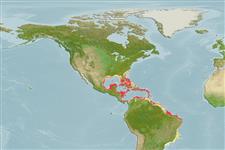
Western Atlantic: Bermuda, South Carolina (USA), and northern Gulf of Mexico to Brazil; throughout the West Indies and the coasts of Central America (Ref. 3798).
Longitud en la primera madurez / Tamaño / Peso / Edad
Madurez: Lm 16.0 range ? - ? cm
Max length : 30.0 cm TL macho / no sexado; (Ref. 7251); common length : 17.0 cm TL macho / no sexado; (Ref. 3798)
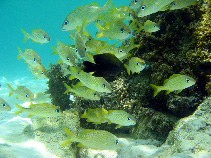
Espinas dorsales (total) : 12; Radios blandos dorsales (total) : 14 - 15; Espinas anales: 3; Radios blandos anales: 8. Mostly yellow, paler below. Scales below lateral line in oblique rows and much larger than those above lateral line. No other grunt has enlarged scales below the lateral line (Ref. 26938).
Body shape (shape guide): short and / or deep.
Occurs in large schools on rocky and coral reefs, often under ledges or close to elkhorn coral (Ref. 9710). Juveniles abundant in near-shore seagrass beds (Ref. 9710). Feeds mainly on small crustaceans (Ref. 3798). Marketed fresh (Ref. 3798).
Ciclo vital y comportamiento de apareamiento
Madurez | Reproducción | Puesta | Huevos | Fecundidad | Larva
Oviparous, distinct pairing during breeding (Ref. 205).
Robins, C.R. and G.C. Ray, 1986. A field guide to Atlantic coast fishes of North America. Houghton Mifflin Company, Boston, U.S.A. 354 p. (Ref. 7251)
Situación en la Lista Roja de la UICN (Ref. 130435: Version 2025-2 (Global))
Amenaza para el ser humano
Reports of ciguatera poisoning (Ref. 30303)
Usos humanos
Pesquerías: comercial; Acuario: Acuarios públicos; carnada: usually
Herramientas
Informes especiales
Descargar XML
Fuentes de Internet
Estimaciones basadas en modelos
Temperatura preferida (Referencia
123201): 25.4 - 28, mean 27.2 °C (based on 240 cells).
Índice de diversidad filogenética (Referencia
82804): PD
50 = 0.5000 [Uniqueness, from 0.5 = low to 2.0 = high].
Bayesian length-weight: a=0.01349 (0.00861 - 0.02114), b=3.00 (2.87 - 3.13), in cm total length, based on LWR estimates for this species & Genus-body shape (Ref.
93245).
Nivel trófico (Referencia
69278): 3.5 ±0.1 se; based on diet studies.
Resiliencia (Referencia
120179): Medio, población duplicada en un tiempo mínimo de 1.4-4.4 años (K=0.24).
Vulnerabilidad pesquera (Ref.
59153): Low to moderate vulnerability (32 of 100).
🛈
Nutrientes (Ref.
124155): Calcium = 26.7 [11.5, 74.1] mg/100g; Iron = 0.579 [0.281, 1.123] mg/100g; Protein = 19.5 [17.5, 21.5] %; Omega3 = 0.169 [0.076, 0.330] g/100g; Selenium = 15.4 [7.0, 31.3] μg/100g; VitaminA = 38 [10, 140] μg/100g; Zinc = 0.714 [0.431, 1.162] mg/100g (wet weight);