>
Eupercaria/misc (Various families in series Eupercaria) >
Priacanthidae (Bigeyes or catalufas)
Etymology: Heteropriacanthus: Greek, heteros = other + Greek, prion = saw + greek, akantha = thorn (Ref. 45335).
More on author: Lacepède.
Taxonomic Remarks
Two former synonyms resurrected: H. carolinus, widespread in Indo-Pacific, and H. fulgens in northeastern Atlantic.
Entorno: milieu / zona climática / rango de profundidad / gama de distribución
Ecología
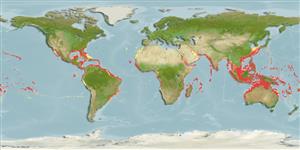
marino asociado a arrecife; rango de profundidad 3 - 300 m (Ref. 27000), usually 3 - 35 m (Ref. 40849). Subtropical; 33°N - 32°S, 180°W - 180°E
Atlantic and Southwest Indian Ocean. Formerly circumglobal.
Tamaño / Peso / Edad
Madurez: Lm ? range ? - ? cm
Max length : 50.7 cm TL macho / no sexado; (Ref. 9990); common length : 20.0 cm SL macho / no sexado; (Ref. 55763); peso máximo publicado: 2.7 kg (Ref. 9990)
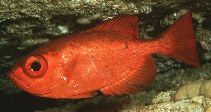
Espinas dorsales (total) : 10; Radios blandos dorsales (total) : 12 - 13; Espinas anales: 3; Radios blandos anales: 13 - 14. Silvery pink, mottled red or solid red in color; median fins with faint dark dots. Pelvic fins dusky or pale and without distinct spots (Ref. 4328). Section of preopercle behind canal striated and without scales (Ref. 26938).
Body shape (shape guide): fusiform / normal; Cross section: compressed.
Common in lagoon and seaward reefs, primarily around islands. Under or near ledges by day (Ref. 9710). Benthopelagic (Ref. 58302). Juvenile pelagic (Ref. 9335). Nocturnal (Ref. 5213), feeding mainly on octopi, pelagic shrimp, stomatopods, crabs, small fish, and polychaetes. Solitary (Ref. 5213). During the day usually occurs singly or in small groups but at dusk it may gather in large numbers (Ref. 37816). Known to produce sound. Marketed fresh (Ref. 3800). Minimum depth reported taken from Ref. 30874.
Ciclo vital y comportamiento de apareamiento
Madurez | Reproducción | Puesta | Huevos | Fecundidad | Larva
Fernandez-Silva, I. and H.-C. Ho, 2017. Revision of the cicrumtropical glasseye fish Heteropriacanthus cruentatus (Perciformes: Priacanthidae), with resurrection of two species. Zootaxa 4273(3):341-361. (Ref. 115564)
Situación en la Lista Roja de la UICN (Ref. 130435: Version 2025-2 (Global))
Amenaza para el ser humano
Reports of ciguatera poisoning (Ref. 30911)
Usos humanos
Pesquerías: escaso valor comercial; pesca deportiva: si; Acuario: Comercial
Herramientas
Informes especiales
Descargar XML
Fuentes de Internet
Estimaciones basadas en modelos
Temperatura preferida (Referencia
123201): 23.3 - 29, mean 27.4 °C (based on 2452 cells).
Índice de diversidad filogenética (Referencia
82804): PD
50 = 0.6250 [Uniqueness, from 0.5 = low to 2.0 = high].
Bayesian length-weight: a=0.01585 (0.00991 - 0.02534), b=2.88 (2.75 - 3.01), in cm total length, based on LWR estimates for this species & (Sub)family-body (Ref.
93245).
Nivel trófico (Referencia
69278): 3.6 ±0.2 se; based on diet studies.
Resiliencia (Referencia
120179): Medio, población duplicada en un tiempo mínimo de 1.4-4.4 años (Preliminary K or Fecundity.).
Vulnerabilidad pesquera (Ref.
59153): Moderate vulnerability (40 of 100).
🛈
Nutrientes (Ref.
124155): Calcium = 26.8 [15.1, 45.6] mg/100g; Iron = 0.664 [0.388, 1.058] mg/100g; Protein = 19.8 [18.7, 20.7] %; Omega3 = 0.249 [0.153, 0.401] g/100g; Selenium = 23.3 [12.4, 43.1] μg/100g; VitaminA = 51.3 [19.6, 136.6] μg/100g; Zinc = 0.625 [0.427, 0.901] mg/100g (wet weight);