Umwelt: Milieu / Klimazone / Tiefenbereich / Verbreitungsgebiet
Ökologie
seewasser; brackwasser riff-verbunden; ozeanodrom (Ref. 51243); tiefenbereich 0 - 20 m (Ref. 86942). Tropical; 32°N - 32°S, 42°E - 139°W
Indo-Pacific: Red Sea to the Hawaiian and Tuamoto Islands, north to southern Japan, south to Lord Howe Island, Australia; throughout Micronesia.
Größe / Gewicht / Alter
Geschlechtsreife: Lm ? range ? - ? cm
Max length : 90.0 cm SL Männchen/unbestimmt; (Ref. 1602); max. veröff. Gewicht: 8.6 kg (Ref. 5450)
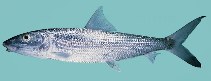
Rückenflossenstacheln (insgesamt) : 0; Rückenflossenweichstrahlen (insgesamt) : 15 - 19; Afterflossenstacheln: 0; Afterflossenweichstrahlen: 8 - 9. Tip of lower jaw broadly rounded; a spot of black pigment often present on the underside of snout, at least in smaller individuals; tooth patches on parasphenoid and basibranchial bones more broadly oval in shape, average width/length 0.38 and 0.45, respectively; number of teeth in pharyngobranchial tooth patch usually 5-15 (Ref. 9828). Compared to A. argentea which has a yellow spot on the axil of the pectoral fin, in this species, there is none (Ref. 74924).
Body shape (shape guide): fusiform / normal.
Inhabits mud flats of turbid inner reefs and mangroves and sandy lagoons (Ref. 9710). Benthopelagic in shallow, coastal areas (Ref. 58302). Grabs food from the substratum using its snout. Feeds on invertebrates, benthic species, mollusks and small crustaceans (Ref. 89972). Can tolerate oxygen poor water by inhaling air into a lung-like air bladder (Ref. 9710). Migrates to mass spawn at seaward mouths of channels on lunar cycle (Ref. 9710). Sold fresh in markets but seldom used for human consumption.
Lebenszyklus und Paarungsverhalten
Geschlechtsreife | Fortpflanzung | Ablaichen | Eier | Fruchtbarkeit | Larven
Spawning occurs in open waters. Eggs are pelagic (Ref. 205).
Myers, R.F., 1991. Micronesian reef fishes. Second Ed. Coral Graphics, Barrigada, Guam. 298 p. (Ref. 1602)
IUCN Rote Liste Status (Ref. 130435: Version 2025-2 (Global))
Bedrohung für Menschen
Harmless
Nutzung durch Menschen
Fischereien: weniger kommerziell; Sportfisch: ja; Köder: usually
Tools
Zusatzinformationen
Download XML
Internet Quellen
Schätzungen auf der Grundlage von Modellen
Bevorzugte Temperatur (Ref.
123201): 24.6 - 29.3, mean 28.1 °C (based on 2148 cells).
Phylogenetischer Diversitätsindex (Ref.
82804): PD
50 = 0.5007 [Uniqueness, from 0.5 = low to 2.0 = high].
Bayesian length-weight: a=0.01318 (0.00552 - 0.03150), b=3.05 (2.85 - 3.25), in cm total length, based on LWR estimates for this (Sub)family-body shape (Ref.
93245).
Trophische Ebene (Ref.
69278): 3.7 ±0.30 se; based on food items.
Generation time: 6.1 ( na - na) years. Estimated as median ln(3)/K based on 1
growth studies.
Widerstandsfähigkeit (Ref.
120179): mittel, Verdopplung der Population dauert 1,4 - 4,4 Jahre. (Preliminary K or Fecundity.).
Anfälligkeit der Fischerei (Ref.
59153): Moderate to high vulnerability (54 of 100).
🛈
Nährstoffe (Ref.
124155): Calcium = 14.4 [1.8, 131.1] mg/100g; Iron = 0.558 [0.052, 5.738] mg/100g; Protein = 19.4 [16.8, 21.8] %; Omega3 = 0.142 [0.042, 0.484] g/100g; Selenium = 27.2 [2.3, 209.3] μg/100g; VitaminA = 41.1 [4.7, 375.9] μg/100g; Zinc = 1.22 [0.13, 12.79] mg/100g (wet weight);