Entorno: milieu / zona climática / rango de profundidad / gama de distribución
Ecología
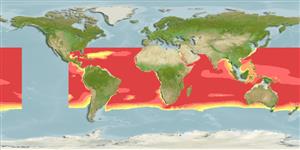
marino batipelágico; rango de profundidad 100 - 1739 m (Ref. 58018). Deep-water; 33°N - 49°S, 98°W - 154°W
Eastern Atlantic: off Portugal south to Morocco including the Azores, Madeira and Canary Islands; off Cape Agulhas, South Africa (Ref. 3991). Western Atlantic: Southeastern Florida and Bermuda to Venezuela, including the Gulf of Mexico and the Caribbean Sea (Ref. 37039). Elsewhere, South Atlantic, tropical and subtropical Indo-Pacific.
Tamaño / Peso / Edad
Madurez: Lm ? range ? - ? cm
Max length : 8.3 cm SL macho / no sexado; (Ref. 4463)
Descripción breve
Claves de identificación | Morfología | Morfometría
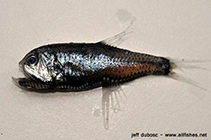
Espinas dorsales (total) : 0; Radios blandos dorsales (total) : 15 - 16; Espinas anales: 0; Radios blandos anales: 21 - 26. Yellowish in color, darker dorsally, opercle silver, caudal base and peduncle dark brown (Ref. 3991). Pectoral and pelvic fins colorless (Ref. 3991). Dorsal adipose fin present.
Body shape (shape guide): fusiform / normal.
Usually associated with continental and island slopes (Ref. 4769). Mesopelagic (Ref. 58302). Occurs at 100-300 m by day, 200-500 m by night (Ref. 4463). Feeds on crustaceans and small fishes (Ref. 4769). Photophore development complete by about 27 mm SL (Ref. 4769).
Ciclo vital y comportamiento de apareamiento
Madurez | Reproducción | Puesta | Huevos | Fecundidad | Larva
Quéro, J.-C., J.C. Njock and M.M. de la Hoz, 1990. Gonostomatidae. p. 283-292. In J.C. Quero, J.C. Hureau, C. Karrer, A. Post and L. Saldanha (eds.) Check-list of the fishes of the eastern tropical Atlantic (CLOFETA). JNICT, Lisbon; SEI, Paris; and UNESCO, Paris. Vol. 1. (Ref. 4463)
Situación en la Lista Roja de la UICN (Ref. 130435: Version 2025-2 (Global))
Amenaza para el ser humano
Harmless
Usos humanos
Pesquerías: sin interés
Herramientas
Informes especiales
Descargar XML
Fuentes de Internet
Estimaciones basadas en modelos
Temperatura preferida (Referencia
123201): 5.7 - 14.7, mean 9.2 °C (based on 768 cells).
Índice de diversidad filogenética (Referencia
82804): PD
50 = 0.7500 [Uniqueness, from 0.5 = low to 2.0 = high].
Bayesian length-weight: a=0.01122 (0.00514 - 0.02450), b=3.04 (2.87 - 3.21), in cm total length, based on all LWR estimates for this body shape (Ref.
93245).
Nivel trófico (Referencia
69278): 3.5 ±0.48 se; based on food items.
Resiliencia (Referencia
120179): Alto, población duplicada en un tiempo mínimo inferior a 15 meses (Preliminary K or Fecundity.).
Vulnerabilidad pesquera (Ref.
59153): Low vulnerability (10 of 100).
🛈