>
Stomiiformes (Lightfishes and dragonfishes) >
Stomiidae (Barbeled dragonfishes) > Melanostomiinae
Etymology: Eustomias: Greek, eu = good + Greek, stoma = mouth (Ref. 45335).
Eponymy: Professor Dr August Bernhard Brauer (1863–1917) was a German herpetologist and ichthyologist. [...] (Ref. 128868), visit book page.
Environnement : milieu / zone climatique / profondeur / gamme de distribution
Écologie
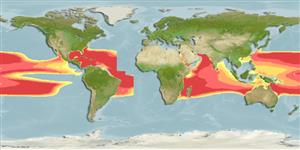
marin bathypélagique; profondeur 0 - 1400 m (Ref. 58018). Tropical; 36°N - 34°S
Eastern Atlantic: off Gibraltar. Western Atlantic: about 30°W to 68°W between 28°N-23°N (to 35°N near 30°W), Lesser Antilles, and off Brazil. Also known from Indian and Pacific Oceans.
Taille / Poids / Âge
Maturité: Lm ? range ? - ? cm
Max length : 13.5 cm SL mâle / non sexé; (Ref. 4740)
Description synthétique
Clés d'identification | Morphologie | Morphométrie
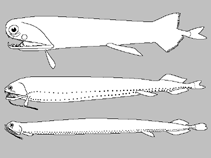
Rayons mous dorsaux (Total) : 22 - 30; Rayons mous anaux: 36 - 41. Body slender and elongate, color black; body depth 7.7-11% SL. Head length 12.5-16.6% SL. Lower jaw about equal to length of upper jaw and is not upturned at tip. Long, tapering, protrusible snout. Chin barbel 12-17% SL. Barbel with slender stem and an ovoid terminal bulb, with 2 filaments varying in length from very short to 3 times length of bulb. Deep ventral groove extends from isthmus to behind pectoral fin base (Ref. 37039).
Body shape (shape guide): elongated.
Cycle de vie et comportement reproducteur
Maturité | Reproduction | Frai | Œufs | Fécondité | Larves
Gibbs, R.H. Jr., 1984. Melanostomiidae. p. 341-365. In P.J.P. Whitehead, M.-L. Bauchot, J.-C. Hureau, J. Nielsen and E. Tortonese (eds.) Fishes of the north-eastern Atlantic and the Mediterranean. UNESCO, Paris. Vol. 1. (Ref. 4740)
Statut dans la liste rouge de l'IUCN (Ref. 130435: Version 2025-2 (Global))
Menace pour l'homme
Harmless
Utilisations par l'homme
Pêcheries: sans intérêt
Outils
Articles particuliers
Télécharger en XML
Sources Internet
Estimations basées sur des modèles
Température préférée (Réf.
123201): 7.8 - 19.1, mean 12.3 °C (based on 235 cells).
Indice de diversité phylogénétique (Réf.
82804): PD
50 = 0.5000 [Uniqueness, from 0.5 = low to 2.0 = high].
Bayesian length-weight: a=0.00302 (0.00115 - 0.00790), b=3.11 (2.88 - 3.34), in cm total length, based on LWR estimates for this (Sub)family-body shape (Ref.
93245).
Niveau trophique (Réf.
69278): 4.2 ±0.8 se; based on size and trophs of closest relatives
Résilience (Réf.
120179): Haut, temps minimum de doublement de population inférieur à 15 mois (Preliminary K or Fecundity.).
Vulnérabilité de la pêche (Ref.
59153): Low vulnerability (10 of 100).
🛈