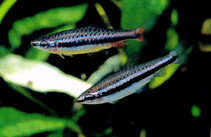
Taxonomic Remarks
The most recent distributional records were published by Weitzman & Weitzman (1982: Fig. 229). Zarske (1993) noted that eleven aquarium bred specimens best identified as Nannostomus nitidus had an adipose fin and some did not, although their wild caught parents had this fin. All specimens described by Weitzman (1978) had this fin. Because of the similarity in many other characters between Nannostomus nitidus and Nannostomus limatus Weitzman (1978), a species without an adipose fin, Zarske (1993) opened the question of the differences between these two species. There remain some differences between these species as designated by Weitzman(1978), for example Nannostomus nitidus lacks a tertiary stripe and has 2-3 inner dentary teeth while Nannostomus limatus has the opposite of these features. Solution of this problem must await statistical analyses of several characters using extensive collections from their native habitat of these tentatively distinct species. Occasionally exported as an aquarium fish, Weitzman et al. (2001).
Ambiente: milieu / zona climatica / distribuzione batimetrica / gamma di distribuzione
Ecologia
; acqua dolce benthopelagico. Tropical; 24°C - 28°C (Ref. 13614)
South America: Capim River basin in Pará, Brazil.
Dimensione / Peso / Età
Maturità: Lm ? range ? - ? cm
Max length : 3.5 cm SL maschio/sesso non determinato; (Ref. 27925)
Ciclo vitale e comportamento di accoppiamento
Maturità | Riproduzione | Deposizione | Uova | Fecondità | Larve
Weitzman, M. and S.H. Weitzman, 2003. Lebiasinidae (Pencil fishes). p. 241-251. In R.E. Reis, S.O. Kullander and C.J. Ferraris, Jr. (eds.) Checklist of the Freshwater Fishes of South and Central America. Porto Alegre: EDIPUCRS, Brasil. (Ref. 37104)
Stato della Lista Rossa IUCN (Ref. 130435: Version 2025-2 (Global))
Minaccia per l'uomo
Harmless
Usi umani
Strumenti
Rapporti speciali
Scarica XML
Fonti Internet
Stime basate su modelli
Indice di diversità filogenetica (Fonte Biblio.
82804): PD
50 = 0.5000 [Uniqueness, from 0.5 = low to 2.0 = high].
Bayesian length-weight: a=0.00646 (0.00280 - 0.01488), b=3.13 (2.93 - 3.33), in cm total length, based on LWR estimates for this (Sub)family-body shape (Ref.
93245).
Livello trofico (Fonte Biblio.
69278): 3.2 ±0.4 se; based on size and trophs of closest relatives
Vulnerabilità della pesca (Ref.
59153): Low vulnerability (10 of 100).
🛈