>
Characiformes (Characins) >
Serrasalmidae (Piranhas and pacus) > Myleinae
Etymology: Myloplus: Greek, mylos, -ou = grey mullet + Greek, plus, ploos = movement of a serpent.
More on authors: Müller & Troschel.
Ambiente: milieu / zona climatica / distribuzione batimetrica / gamma di distribuzione
Ecologia
; acqua dolce benthopelagico; pH range: 5.0 - 7.0; dH range: ? - 15. Tropical; 23°C - 27°C (Ref. 13371)
South America: Amazon and Orinoco River basins; north and eastern Guiana Shield rivers.
Dimensione / Peso / Età
Maturità: Lm ? range ? - ? cm
Max length : 41.5 cm TL maschio/sesso non determinato; (Ref. 111518); peso massimo pubblicato: 2.5 kg (Ref. 27188)
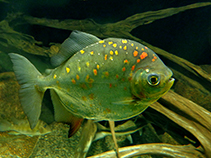
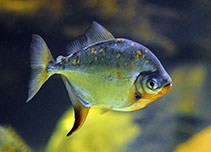
Gregarious and non-aggressive (Ref. 27188). Individuals prefer calm zones of main rivers where the vegetation hangs over the river banks. Migratory behaviour is undetermined (Ref. 126106). Adults feed on the leaves of river plants (Ref. 12225). They possess powerful dentition that can cause serious bites. Reproduction has not yet been carried out in captivity (Ref. 27188).
Ciclo vitale e comportamento di accoppiamento
Maturità | Riproduzione | Deposizione | Uova | Fecondità | Larve
The red hooked anal fin of the female is actually a plough. The male has a bilobed anal fin which is designed to wrap around the female's "hook". During spawning, the female inserts the hook into the substrate (e.g., gravel) and ploughs a furrow while laying the eggs with the male in a position next to her with his bi-lobed fin wrapped around the hook as he fertilises the eggs. The female's "hook" is suprisingly strong and can be pushed into coarse gravel (up to the anal opening) without any problem with a shaking body action, the male's bilobed hook folds under the same pressure so they can work in unison (Ref. 55767).
Ortega, H. and R.P. Vari, 1986. Annotated checklist of the freshwater fishes of Peru. Smithson. Contrib. Zool. (437):1-25. (Ref. 6329)
Stato della Lista Rossa IUCN (Ref. 130435: Version 2025-2 (Global))
Minaccia per l'uomo
Traumatogenic
Usi umani
Pesca: scarso interesse commerciale; Acquario: Commerciale
Strumenti
Rapporti speciali
Scarica XML
Fonti Internet
Stime basate su modelli
Indice di diversità filogenetica (Fonte Biblio.
82804): PD
50 = 0.5001 [Uniqueness, from 0.5 = low to 2.0 = high].
Bayesian length-weight: a=0.02344 (0.01389 - 0.03957), b=2.97 (2.82 - 3.12), in cm total length, based on LWR estimates for this species & Genus-body shape (Ref.
93245).
Livello trofico (Fonte Biblio.
69278): 2.0 ±0.00 se; based on food items.
Resilienza (Fonte Biblio.
120179): Alto, tempo minimo di raddoppiamento della popolazione meno di 15 mesi (Preliminary K or Fecundity.).
Vulnerabilità della pesca (Ref.
59153): Low to moderate vulnerability (32 of 100).
🛈