>
Cyprinodontiformes (Rivulines, killifishes and live bearers) >
Poeciliidae (Poeciliids) > Poeciliinae
Etymology: Phallichthys: Greek, phallos = penis + Greek, ichthys = fish (Ref. 45335).
Environnement : milieu / zone climatique / profondeur / gamme de distribution
Écologie
; eau douce démersal; pH range: 6.0 - 8.0; dH range: 9 - 19; non migrateur. Tropical; 24°C - 27°C (Ref. 30491)
Central America: Atlantic drainages, from southern Guatemala to Costa Rica and Panama.
Taille / Poids / Âge
Maturité: Lm ? range ? - ? cm
Max length : 7.0 cm SL mâle / non sexé; (Ref. 36880); 6.0 cm TL (female)
Description synthétique
Clés d'identification | Morphologie | Morphométrie
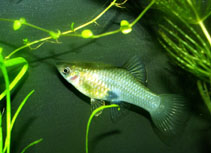
Robust body gray with bluish highlights, deep and almost rhomboid. Males with very long gonopodium that reaches the base of the tail; together with the young, with 6 - 8 dark bars (diffused in females) (Ref. 36880).
Body shape (shape guide): elongated; Cross section: oval.
Occurs mainly in stagnant waters, creeks and river shorelines, over soft bottoms. On the Atlantic versant it lives between 0 and 500 m of elevation, but in the northern Pacific sector is found between 10 and 45 m in the Tempisque and Bebedero drainages; in the Río Tárcoles drainage, where it was probably introduced, it lives between 670 and 1220 m elevation. Inhabits shallow waters with mud or litter substrata in temperatures of 20 to 37°C. Feeds on ooze, detritus, diatoms and occasionally on filamentous algae and aquatic insects (Ref. 36880).
Cycle de vie et comportement reproducteur
Maturité | Reproduction | Frai | Œufs | Fécondité | Larves
Produces 10-80 young after 28 days gestation (Ref. 2060).
Bussing, W.A., 1998. Peces de las aguas continentales de Costa Rica [Freshwater fishes of Costa Rica]. 2nd Ed. San José Costa Rica: Editorial de la Universidad de Costa Rica. 468 p. (Ref. 36880)
Statut dans la liste rouge de l'IUCN (Ref. 130435: Version 2025-2 (Global))
Menace pour l'homme
Harmless
Utilisations par l'homme
Pêcheries: commercial; Aquarium: Commercial
Outils
Articles particuliers
Télécharger en XML
Sources Internet
Estimations basées sur des modèles
Indice de diversité phylogénétique (Réf.
82804): PD
50 = 0.5625 [Uniqueness, from 0.5 = low to 2.0 = high].
Bayesian length-weight: a=0.01000 (0.00501 - 0.01995), b=3.20 (3.03 - 3.37), in cm total length, based on LWR estimates for this species & (Sub)family-body (Ref.
93245).
Niveau trophique (Réf.
69278): 2.3 ±0.17 se; based on food items.
Résilience (Réf.
120179): Milieu, temps minimum de doublement de population : 1,4 à 4,4 années (Preliminary K or Fecundity.).
Vulnérabilité de la pêche (Ref.
59153): Low vulnerability (10 of 100).
🛈