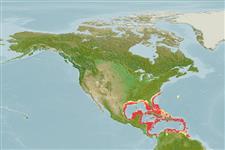
Entorno: milieu / zona climática / rango de profundidad / gama de distribución
Ecología
marino asociado a arrecife; no migratorio (Ref. 56524); rango de profundidad 0 - 170 m (Ref. 9710). Subtropical; 36°N - 6°N, 98°W - 58°W (Ref. 5222)
Western Central Atlantic: North Carolina to southern Florida (USA), Bermuda, Gulf of Mexico, Bahamas, and the Caribbean; including the Antilles (Ref. 26938).
Longitud en la primera madurez / Tamaño / Peso / Edad
Madurez: Lm 16.0, range 14 - ? cm
Max length : 42.6 cm TL macho / no sexado; (Ref. 40637); common length : 20.0 cm TL macho / no sexado; (Ref. 3708); peso máximo publicado: 1.1 kg (Ref. 40637); edad máxima reportada: 13 años (Ref. 36271)
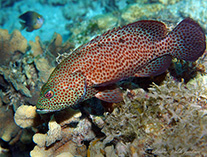
Espinas dorsales (total) : 9; Radios blandos dorsales (total) : 13 - 15; Espinas anales: 3; Radios blandos anales: 8. Distinguished by having the following characteristics: body depth 2.5-2.9 times in SL; head length 2.4-2.6 times in SL (Ref. 089707); opercle with 3 flat spines, middle one the largest and upper spine longer than the lowest; pelvic fins shorter than pectorals; bases of soft dorsal and anal fins covered with scales and thick skin; has 4 contrasting spots, white or black, along body below dorsal fin base (Ref. 26938); color in market: pale orange, grey or brown with reddish spots; black spots on the upper body below the dorsal fin (Ref. 089707).
Body shape (shape guide): fusiform / normal; Cross section: oval.
Inhabits Thalassia beds and coral reefs. In the Gulf of Mexico, they are found on rocky reef ledge in depths greater than 27 m. Solitary (Ref. 26340) and secretive, they usually stay near hiding places during the day. Prefer to remain within a small area of the home range of about 2,120 square m especially during the day (Ref. 56524). Nocturnal predators, adults feed mainly on fishes, with preference on Chromis multilineata, while juveniles feed on shrimps. Due to its small size, this is not a particularly sought-after species. Easily approached and fed by divers (Ref. 9710). Protogynous (Ref. 26938). Between 1995 and 2000, at least 10 specimens have been traded as aquarium fish at Ceará, Brazil (Ref. 49392).
Most change sex between 20 and 23 cm (ages 4 and 5), with sexual transition occurring immediately after spawning in August and September (Ref. 3092).
Heemstra, P.C. and J.E. Randall, 1993. FAO Species Catalogue. Vol. 16. Groupers of the world (family Serranidae, subfamily Epinephelinae). An annotated and illustrated catalogue of the grouper, rockcod, hind, coral grouper and lyretail species known to date. Rome: FAO. FAO Fish. Synop. 125(16):382 p. (Ref. 5222)
Situación en la Lista Roja de la UICN (Ref. 130435: Version 2025-2 (Global))
Amenaza para el ser humano
Reports of ciguatera poisoning (Ref. 30303)
Usos humanos
Pesquerías: escaso valor comercial
Herramientas
Informes especiales
Descargar XML
Fuentes de Internet
Estimaciones basadas en modelos
Temperatura preferida (Referencia
123201): 22.7 - 28, mean 26.4 °C (based on 328 cells).
Índice de diversidad filogenética (Referencia
82804): PD
50 = 0.5000 [Uniqueness, from 0.5 = low to 2.0 = high].
Bayesian length-weight: a=0.01148 (0.00671 - 0.01964), b=3.07 (2.93 - 3.21), in cm total length, based on LWR estimates for this species & Genus-body shape (Ref.
93245).
Nivel trófico (Referencia
69278): 4.3 ±0.6 se; based on diet studies.
Resiliencia (Referencia
120179): Medio, población duplicada en un tiempo mínimo de 1.4-4.4 años (K=0.34-0.35; tm=3.5-5.5; tmax=9; Fec=260,000).
Vulnerabilidad pesquera (Ref.
59153): Low to moderate vulnerability (33 of 100).
🛈
Nutrientes (Ref.
124155): Calcium = 28.1 [12.8, 57.6] mg/100g; Iron = 0.548 [0.279, 1.129] mg/100g; Protein = 19.3 [17.4, 20.9] %; Omega3 = 0.285 [0.157, 0.507] g/100g; Selenium = 21.1 [9.8, 42.1] μg/100g; VitaminA = 86.8 [30.2, 314.7] μg/100g; Zinc = 0.479 [0.320, 0.816] mg/100g (wet weight);