Milieu: milieu / Klimaatzone / Diepte / verspreidingsgebied
Ecologie
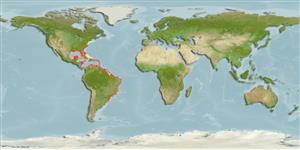
marien rifbewoner; diepte 1 - 80 m (Ref. 5217). Subtropical; 42°N - 35°S, 98°W - 28°W
Western Atlantic: North Carolina, USA, the northern Gulf of Mexico and the Bahamas southward to Uruguay. Occurrence in western Caribbean is doubtful (Ref. 26938).
Lengte bij maturiteit / Grootte / Gewicht / Leeftijd
Maturiteit: Lm 12.9 range ? - ? cm
Max length : 30.0 cm TL mannelijk / geslacht onbekend; (Ref. 7251); common length : 16.0 cm TL mannelijk / geslacht onbekend; (Ref. 5217)
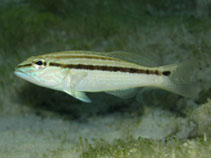
Dorsale stekels (totaal) : 10; Dorsale zachte stralen (totaal) : 12; Anale stekels: 3; Anale zachte stralen: 7 - 8. Body pale brown dorsally with several vertical dark brown bars, becoming white ventrally; dorsal fin dusky with longitudinal yellow lines; pectoral, pelvic and anal fins dusky; caudal fin dusky with small yellow blotches (Ref. 13608). Preopercle has spines radiating from 2 centers (Ref. 26938).
Body shape (shape guide): fusiform / normal.
Inhabits bays, coastal grassy areas and shallow banks. Solitary (Ref. 26340) and retreats into shelter when frightened (Ref. 9710). Neither opercular spine nor anterolateral glandular grooves with venom gland is present (Ref. 57406). Synchronously hermaphroditic. Popular as a pan fish despite its small size.
Levenscyclus en paargedrag
Maturiteit | Voortplanting | Paaien | Eieren | Fecunditeit | Larven
Simultaenous hermaphrodite. The gonad contains ovarian and testicular tissue separated by a thin basement membrane, with no means of internal self-fertilization.
Robins, C.R. and G.C. Ray, 1986. A field guide to Atlantic coast fishes of North America. Houghton Mifflin Company, Boston, U.S.A. 354 p. (Ref. 7251)
Status op de Rode Lijst van het IUCN (Ref. 130435: Version 2025-2 (Global))
Gebruik door de mens
Visserij: commercieel; sportvis: ja
Tools
Speciale rapporten
Download XML
Internetbronnen
Schattingen op basis van modellen
Gewenste temperatuur (Ref.
123201): 21.9 - 28, mean 25.2 °C (based on 542 cells).
Fylogenetische diversiteitsindex (Ref.
82804): PD
50 = 0.5002 [Uniqueness, from 0.5 = low to 2.0 = high].
Bayesian length-weight: a=0.00912 (0.00753 - 0.01104), b=3.09 (3.05 - 3.13), in cm total length, based on LWR estimates for this species (Ref.
93245).
Trofisch niveau (Ref.
69278): 4.5 ±0.0 se; based on diet studies.
Generation time: 3.8 ( na - na) years. Estimated as median ln(3)/K based on 2
growth studies.
Weerstandsvermogen (Ref.
120179): Hoog, minimale populatieverdubbelingstijd minder dan 15 maanden (K=0.29-1.5; tm=1.01).
Kwetsbaarheid van de visserij (Ref.
59153): Low vulnerability (15 of 100).
🛈
Kwetsbaarheid voor het klimaat (Ref.
125649): Moderate vulnerability (36 of 100).
🛈
Voedingsstoffen (Ref.
124155): Calcium = 45.5 [21.2, 110.6] mg/100g; Iron = 0.928 [0.416, 1.865] mg/100g; Protein = 19.6 [17.6, 21.4] %; Omega3 = 0.276 [0.136, 0.546] g/100g; Selenium = 21.5 [9.2, 50.2] μg/100g; VitaminA = 46.5 [12.7, 213.2] μg/100g; Zinc = 0.712 [0.414, 1.183] mg/100g (wet weight);