>
Anabantiformes (Gouramies, snakeheads) >
Osphronemidae (Gouramies) > Macropodusinae
Etymology: Betta: Malay/Javanese origin. Bleeker (1850, 1858) indicates Ikan Wadder Bettah as the local name of Betta trifasciata Bleeker, 1849 (now Betta picta, Valenciennes, 1846) in the Ambarawa Javanese dialect. Ikan Wader is a common Javanese name for smaller freshwater fishes, especially cyprinids (already used in Old Javanese). See Blust, R. & Trussel, S. Austronesian Comparative Dictionary. Web Edition (https://www.trussel2.com/acd/).
More on author: Regan.
Περιβάλλον: περιβάλλον / κλιματική ζώνη / εύρος βάθους / εύρος διανομής
Οικολογία
; Γλυκού νερού βενθοπελαγικό; pH range: 5.5 - 6.8; dH range: ? - 12. Tropical; 21°C - 27°C (Ref. 2059)
Asia: Borneo.
Μέγεθος / Βάρος / Ηλικία
Γεννητική Ωρίμανση: Lm ? range ? - ? cm
Max length : 14.0 cm TL αρσενικό/απροσδιόριστο; (Ref. 7050)
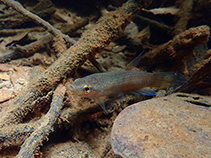
Ραχιαίες άκανθες (συνολικά) : 1; Μαλακές ραχιαίες ακτίνες (συνολικά) : 7 - 8; Εδρικές άκανθες: 1 - 2; Μαλακές εδρικές ακτίνες: 26 - 28; Σπόνδυλοι: 31 - 32. Differs from other members of the species group by the following combination of characters: opercle with uninterrupted second postorbital stripe; yellow eye when live; anal fin rays 28-30 (mode 28); subdorsal scales 5-6 (mode 5); lateral scales 31-33 (mode 32); predorsal scales 22-25 (mode 23); postdorsal scales 10-12 (mode 11); preanal length 43.4-48.5% SL; head length 29.8-34.9% SL; anal fin base length 49.6-56.8% SL (Ref. 55025).
Body shape (shape guide): fusiform / normal.
Facultative air-breathing (Ref. 126274); Occurs in habitats ranging from peat swamp forest to acid water swamp forest (Ref. 55025). Normally found in a more stagnant sections of streams among the submerged leaf litter and overhanging bank vegetation (Ref. 55025). Mouth brooder (Ref. 55025)
Κύκλος ζωής και συμπεριφορά ζευγαρώματος
Γεννητική Ωρίμανση | Αναπαραγωγή | Γεννοβολία | Αβγά | Γονιμότητα | Προνύμφες
A paternal mouth brooder, exhibiting the typical egg exchange between female and male. After the nuptial embrace, the female picks up the fertilized egg from the male's curved body, proceeds to transfer the eggs to the male for oral brooding by spitting out the eggs and the male gulps the eggs into its buccal sac. Male sometimes rejects the eggs, but the female continues spitting and gulping the eggs until the male finally accepts. This process continues until all the fertilized eggs have been transferred, then another bout of egg laying occurs with the whole procedure repeated.
Kottelat, M., A.J. Whitten, S.N. Kartikasari and S. Wirjoatmodjo, 1993. Freshwater fishes of Western Indonesia and Sulawesi. Periplus Editions, Hong Kong. 221 p. (Ref. 7050)
Κατάσταση Κόκκινου Καταλόγου IUCN (Ref. 130435: Version 2025-2 (Global))
Απειλή για τον άνθρωπο
Harmless
Ανθρώπινες χρήσεις
αλιεία: Εμπορικό(ά); Ενυδρείο: Εμπορικό(ά)
Εργαλεία
Ειδικές εκθέσεις
Λήψη XML
Διαδικτυακές πηγές
Εκτιμήσεις βάσει μοντέλων
Δείκτης φυλογενετικής ποικιλότητας (Αναφ.
82804): PD
50 = 0.5000 [Uniqueness, from 0.5 = low to 2.0 = high].
Bayesian length-weight: a=0.01000 (0.00374 - 0.02675), b=2.97 (2.74 - 3.20), in cm total length, based on LWR estimates for this (Sub)family-body shape (Ref.
93245).
Τροφικό Επίπεδο (Αναφ.
69278): 3.3 ±0.4 se; based on size and trophs of closest relatives
Ελαστικότητα (Αναφ.
120179): Υψηλό, ελάχιστος χρόνος για διπλασιασμό πληθυσμού < 15 μήνες (Preliminary K or Fecundity.).
Ευπάθεια στην αλιεία (Ref.
59153): Low vulnerability (10 of 100).
🛈