>
Anabantiformes (Gouramies, snakeheads) >
Osphronemidae (Gouramies) > Macropodusinae
Etymology: Betta: Malay/Javanese origin. Bleeker (1850, 1858) indicates Ikan Wadder Bettah as the local name of Betta trifasciata Bleeker, 1849 (now Betta picta, Valenciennes, 1846) in the Ambarawa Javanese dialect. Ikan Wader is a common Javanese name for smaller freshwater fishes, especially cyprinids (already used in Old Javanese). See Blust, R. & Trussel, S. Austronesian Comparative Dictionary. Web Edition (https://www.trussel2.com/acd/).
Environnement : milieu / zone climatique / profondeur / gamme de distribution
Écologie
; eau douce benthopélagique; pH range: 6.0 - 7.0; dH range: 5 - 19. Tropical; 24°C - 28°C (Ref. 1672)
Asia: Thailand, Malaysia, Singapore and Indonesia.
Taille / Poids / Âge
Maturité: Lm ? range ? - ? cm
Max length : 6.0 cm SL mâle / non sexé; (Ref. 57235)
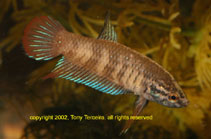
Diagnosed by having the following combination of characters: A bright red crescent on distal edge of caudal fin; absence of caudal transverse bars; dorsal transverse bars on distal two-thirds of dorsal fin; iridescent blue opercle scales; body dark brown to black; lateral scales 30-32; body depth 24.2-30.1% SL; dorsal-fin origin above lateral scales 15-17 (mode 16); length of dorsal-fin fin base 12.9-18.9% SL; and height of pectoral-fin origin 14.8-18.9% SL (Ref. 56613).
Body shape (shape guide): fusiform / normal.
Facultative air-breathing (Ref. 126274); Occurs usually in stagnant pools and ditches in clear to brown water (Ref. 56613). Found also in lowland swamps and paddy field. Bubble nest builder species (Ref. 57235). Eggs shrink to the bottom and were then collected by one or both parents and were embedded among the foam bubbles in the nest (Ref. 41595).
Cycle de vie et comportement reproducteur
Maturité | Reproduction | Frai | Œufs | Fécondité | Larves
Eggs shrink to the bottom and were then collected by one or both parents and were embedded among the foam bubbles in the nest (Ref. 41595).
Kottelat, M., A.J. Whitten, S.N. Kartikasari and S. Wirjoatmodjo, 1993. Freshwater fishes of Western Indonesia and Sulawesi. Periplus Editions, Hong Kong. 221 p. (Ref. 7050)
Statut dans la liste rouge de l'IUCN (Ref. 130435: Version 2025-2 (Global))
Menace pour l'homme
Harmless
Utilisations par l'homme
Pêcheries: commercial; Aquarium: Commercial
Outils
Articles particuliers
Télécharger en XML
Sources Internet
Estimations basées sur des modèles
Indice de diversité phylogénétique (Réf.
82804): PD
50 = 0.5000 [Uniqueness, from 0.5 = low to 2.0 = high].
Bayesian length-weight: a=0.01000 (0.00374 - 0.02675), b=2.97 (2.74 - 3.20), in cm total length, based on LWR estimates for this (Sub)family-body shape (Ref.
93245).
Niveau trophique (Réf.
69278): 3.2 ±0.4 se; based on size and trophs of closest relatives
Résilience (Réf.
120179): Haut, temps minimum de doublement de population inférieur à 15 mois (Preliminary K or Fecundity.).
Vulnérabilité de la pêche (Ref.
59153): Low vulnerability (10 of 100).
🛈