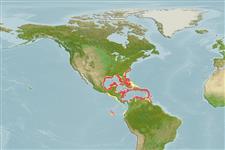
Ambiente: milieu / zona climatica / distribuzione batimetrica / gamma di distribuzione
Ecologia
marino batidemersale; distribuzione batimetrica 30 - 400 m (Ref. 5222). Deep-water; 35°N - 3°S, 98°W - 58°W (Ref. 5222)
Western Atlantic: Bermuda, North Carolina (USA), Florida (USA), Gulf of Mexico, Bahamas, Cuba, Yucatan (Mexico), Jamaica, Puerto Rico, the Virgin Islands, and the Leeward islands to Trinidad. Eastern Pacific: Galapagos Islands.
Dimensione / Peso / Età
Maturità: Lm ? range ? - ? cm
Max length : 160 cm TL maschio/sesso non determinato; (Ref. 3244); 100.0 cm TL (female); peso massimo pubblicato: 107.0 kg (Ref. 3244)
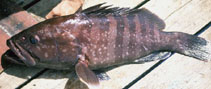
Spine dorsali (totale) : 11; Raggi dorsali molli (totale) : 14 - 15; Spine anali: 3; Raggi anali molli: 8 - 9. With 8 or 9 regular vertical darker brown bars on side. The only grouper in the Caribbean with a pattern of regular dark bars (Ref. 26938). Further distinguished by the following characteristics: head and body buff; blackish brown pelvic fins; prominent blackish brown maxillary streak on the cheek along upper edge of the maxilla; depth of body contained 2.4-2.9 times in SL; head length 2.3-2.5 times in SL; convex interorbital area; rounded preopercle angle, with enlarged serrae, 1-2 small serrae at lower edge, just in front of the angle; serrate interopercle and subopercle; posterior nostrils greatly enlarged, diameter is 4 or more times larger than anterior nostrils (Ref. 89707).
Body shape (shape guide): fusiform / normal; Cross section: compressed.
A solitary (Ref. 26340), deep-water species reported from 100-400 m; juveniles sometimes in water as shallow as 30 m. Feeds on fishes, crustaceans, and squids (Ref. 89707). Virtually nothing is known of the age, growth, and reproduction of this species. Marketed fresh.
Ciclo vitale e comportamento di accoppiamento
Maturità | Riproduzione | Deposizione | Uova | Fecondità | Larve
Craig, M.T. and P.A. Hastings, 2007. A molecular phylogeny of the groupers of the subfamily Epinephelinae (Serranidae) with revised classification of the epinephelini. Ichthyol. Res. 54:1-17. (Ref. 83414)
Stato della Lista Rossa IUCN (Ref. 130435: Version 2025-2 (Global))
Minaccia per l'uomo
Harmless
Usi umani
Pesca: commerciale; Pesce da pesca sportiva: si
Strumenti
Rapporti speciali
Scarica XML
Fonti Internet
Stime basate su modelli
Temperatura preferita (Fonte Biblio.
123201): 16.8 - 26.1, mean 21.7 °C (based on 68 cells).
Indice di diversità filogenetica (Fonte Biblio.
82804): PD
50 = 0.5000 [Uniqueness, from 0.5 = low to 2.0 = high].
Bayesian length-weight: a=0.01318 (0.00598 - 0.02904), b=3.04 (2.87 - 3.21), in cm total length, based on LWR estimates for this Genus-body shape (Ref.
93245).
Livello trofico (Fonte Biblio.
69278): 4.6 ±0.0 se; based on diet studies.
Resilienza (Fonte Biblio.
120179): Molto basso, tempo minimo di raddoppiamento della popolazione più di 14 anni (Preliminary K or Fecundity.).
Vulnerabilità della pesca (Ref.
59153): Very high vulnerability (90 of 100).
🛈
Nutrienti (Ref.
124155): Calcium = 10.5 [5.1, 24.3] mg/100g; Iron = 0.287 [0.135, 0.621] mg/100g; Protein = 17.8 [15.9, 19.6] %; Omega3 = 0.342 [0.178, 0.655] g/100g; Selenium = 21 [9, 49] μg/100g; VitaminA = 8.34 [1.56, 44.48] μg/100g; Zinc = 0.266 [0.183, 0.408] mg/100g (wet weight);