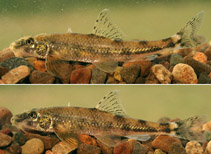
Environnement : milieu / zone climatique / profondeur / gamme de distribution
Écologie
; eau douce benthopélagique. Temperate; 49°N - 43°N, 8°E - 28°E
Europe: Danube drainage (absent from Danube main river except upper course and stretches with fast current).
Taille / Poids / Âge
Maturité: Lm ? range ? - ? cm
Max length : 10.0 cm SL mâle / non sexé; (Ref. 59043)
Description synthétique
Clés d'identification | Morphologie | Morphométrie
Diagnosed from its congeners in Black Sea basin by having the following characters: anus situated midway between pelvic and anal origins or closer to anal origin; predorsal scales without longitudinal epithelial crests; caudal peduncle depth 3.0-3.5 times in its length; dorsal and caudal rays with faint dark spots, forming one dark vertical row (Ref. 59043).
Body shape (shape guide): elongated.
Adults inhabit riffles of small, fast-flowing rivers and bottom of large rivers with water velocities of 0.7 m/s and more, stone bottom, in submontane zone. Young individuals prefer areas with slow current and shallow shoreline on sand bottom. Adults are nocturnal and solitary while juveniles are diurnal. Spawning occurs in shallow areas with very high current of about 1 m/s (Ref. 59043). Adults feed on insects and benthic invertebrates (Ref. 556). Are sensitive to pollution and damming; locally threatened, especially in western and southern Danube drainage; extirpated in the upper Danube (Ref. 59043).
Cycle de vie et comportement reproducteur
Maturité | Reproduction | Frai | Œufs | Fécondité | Larves
Both male and female move to surface or open water to spawn. Eggs drift with current, sink to bottom and stick to substrate (Ref. 59043).
Kottelat, M. and J. Freyhof, 2007. Handbook of European freshwater fishes. Publications Kottelat, Cornol and Freyhof, Berlin. 646 pp. (Ref. 59043)
Statut dans la liste rouge de l'IUCN (Ref. 130435: Version 2025-2 (Global))
Menace pour l'homme
Harmless
Utilisations par l'homme
Pêcheries: sans intérêt; Aquarium: Aquariums publics
Outils
Articles particuliers
Télécharger en XML
Sources Internet
Estimations basées sur des modèles
Indice de diversité phylogénétique (Réf.
82804): PD
50 = 0.5000 [Uniqueness, from 0.5 = low to 2.0 = high].
Bayesian length-weight: a=0.00617 (0.00301 - 0.01264), b=3.12 (2.95 - 3.29), in cm total length, based on LWR estimates for this (Sub)family-body shape (Ref.
93245).
Niveau trophique (Réf.
69278): 3.3 ±0.39 se; based on food items.
Résilience (Réf.
120179): Haut, temps minimum de doublement de population inférieur à 15 mois (Preliminary K or Fecundity.).
Vulnérabilité de la pêche (Ref.
59153): Low vulnerability (10 of 100).
🛈