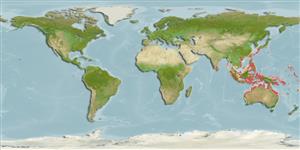
Environnement : milieu / zone climatique / profondeur / gamme de distribution
Écologie
marin; saumâtre récifal; profondeur 1 - 12 m (Ref. 90102). Tropical
Indo-West Pacific: Indo-Australian Archipelago.
Taille / Poids / Âge
Maturité: Lm ? range ? - ? cm
Max length : 134 cm TL mâle / non sexé; (Ref. 2334); common length : 40.0 cm TL mâle / non sexé; (Ref. 9801)
Description synthétique
Clés d'identification | Morphologie | Morphométrie
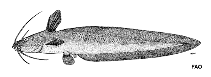
Épines dorsales (Total) : 1; Rayons mous dorsaux (Total) : 104 - 115; Épines anales: 0; Rayons mous anaux: 90 - 100. Differs from Paraplotosus butleri in having a shorter dorsal fin and shorter nasal barbels, rounded pectoral fin shape, fewer upper procurrent caudal fin rays, and fewer gill rakers. Differs from P. muelleri in having a shorter dorsal fin and smaller eye (Ref. 31103). Color highly variable, ranging from pale grey or yellowish brown to dark brown, nearly blackish, sometimes with pronounced dark mottling; generally whitish on belly and ventral part of head; fins brown to blackish, frequently darker than body (Ref. 31103).
Body shape (shape guide): elongated; Cross section: circular.
In tropical areas, inhabits clear and turbid coral reefs; usually found in areas with mixed sand, weed, and coral areas (Ref. 31103). May be seen resting on sand bottoms under ledges or around coral bommies (Ref. 31103). Adults solitarily or in small groups. Presumably nocturnal (Ref. 31103). Feeds on gastropod mollusks and crustaceans (Ref. 31103). Spines associated with anterior fins have potent venom (Ref. 9801).
Cycle de vie et comportement reproducteur
Maturité | Reproduction | Frai | Œufs | Fécondité | Larves
Allen, G.R., 1998. A review of the marine catfish genus Paraplotosus (Plotosidae) with the description of a new species from north-western Australia. Raf. Bull. Zool. 46(1):123-134. (Ref. 31103)
Statut dans la liste rouge de l'IUCN (Ref. 130435: Version 2025-2 (Global))
Utilisations par l'homme
Pêcheries: intérêt commercial mineur
Outils
Articles particuliers
Télécharger en XML
Sources Internet
Estimations basées sur des modèles
Température préférée (Réf.
123201): 24.2 - 29.3, mean 28.5 °C (based on 2310 cells).
Indice de diversité phylogénétique (Réf.
82804): PD
50 = 0.6250 [Uniqueness, from 0.5 = low to 2.0 = high].
Bayesian length-weight: a=0.00468 (0.00210 - 0.01040), b=3.06 (2.86 - 3.26), in cm total length, based on LWR estimates for this (Sub)family-body shape (Ref.
93245).
Niveau trophique (Réf.
69278): 3.4 ±0.54 se; based on food items.
Résilience (Réf.
120179): Faible, temps minimum de doublement de population : 4,5 à 14 années (Preliminary K or Fecundity.).
Vulnérabilité de la pêche (Ref.
59153): Very high vulnerability (80 of 100).
🛈
Nutriments (Ref.
124155): Calcium = 26.6 [11.5, 53.2] mg/100g; Iron = 0.437 [0.248, 0.789] mg/100g; Protein = 17.4 [15.5, 19.6] %; Omega3 = 0.0738 [, ] g/100g; Selenium = 37.8 [19.2, 80.7] μg/100g; VitaminA = 42.4 [14.3, 124.5] μg/100g; Zinc = 1.12 [0.77, 1.59] mg/100g (wet weight); based on
nutrient studies.