Taxonomic Remarks
Molecular studies by Craig & Hasting (2007: Ref. 83414) and Ma et al. (2018: Ref. 119507) placed this species in the genus Cephalopholis.
Ambiente: milieu / zona climatica / distribuzione batimetrica / gamma di distribuzione
Ecologia
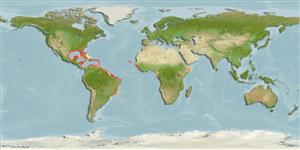
marino associati a barriera corallina; distribuzione batimetrica 8 - 100 m (Ref. 9710), usually 10 - 66 m (Ref. 13442). Subtropical; 35°N - 28°S, 98°W - 10°E (Ref. 5222)
Eastern Atlantic: Ascension Island and Gulf of Guinea islands of Principe, São Tomé, and Annobon. Western Atlantic: Bermuda, Florida, Gulf of Mexico, Campeche Bank, and throughout the Caribbean (except in northern Bahamas) to Sao Paulo, Brazil.
Dimensione / Peso / Età
Maturità: Lm ? range ? - ? cm
Max length : 30.0 cm SL maschio/sesso non determinato; (Ref. 26938); common length : 20.0 cm TL maschio/sesso non determinato; (Ref. 2739)
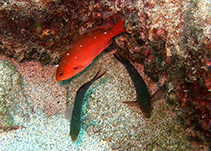
Spine dorsali (totale) : 9; Raggi dorsali molli (totale) : 17 - 19; Spine anali: 3; Raggi anali molli: 8 - 10. Distinguished by the following characteristics: Head short (less than 35% of SL) (Ref. 26938); head and body reddish brown, paler ventrally; bright orange-red spot at the upper end of the pectoral-fin base; 3 widely spaced white spots between lateral line and dorsal-fin base; 2 blue lines on the cheek, one approximately horizontal and tangential to the lower edge of the eye, other along the upper edge of maxilla and continued onto the lower part of the cheek; depth of body contained 2.9-3.4 times in SL; subangular preopercle, vertical edge and rear half of lower edge finely serrate; subequal posterior and anterior nostrils (Ref. 89707).
Body shape (shape guide): fusiform / normal; Cross section: oval.
Inhabits coral reefs and hard bottom areas. Observed in feeding aggregations well above the reef. Feeds mainly in midwater on zooplankton (copepods, pelagic tunicates, shrimps and shrimp larvae). Retreats instantly when alarmed (Ref. 9710).
Ciclo vitale e comportamento di accoppiamento
Maturità | Riproduzione | Deposizione | Uova | Fecondità | Larve
Heemstra, P.C. and J.E. Randall, 1993. FAO Species Catalogue. Vol. 16. Groupers of the world (family Serranidae, subfamily Epinephelinae). An annotated and illustrated catalogue of the grouper, rockcod, hind, coral grouper and lyretail species known to date. Rome: FAO. FAO Fish. Synop. 125(16):382 p. (Ref. 5222)
Stato della Lista Rossa IUCN (Ref. 130435: Version 2025-2 (Global))
Minaccia per l'uomo
Harmless
Usi umani
Pesca: pesca di sussistenza; Pesce da pesca sportiva: si; Acquario: Commerciale; esca: usually
Strumenti
Rapporti speciali
Scarica XML
Fonti Internet
Stime basate su modelli
Temperatura preferita (Fonte Biblio.
123201): 21.2 - 28, mean 26.1 °C (based on 704 cells).
Indice di diversità filogenetica (Fonte Biblio.
82804): PD
50 = 1.0000 [Uniqueness, from 0.5 = low to 2.0 = high].
Bayesian length-weight: a=0.01122 (0.00550 - 0.02289), b=3.04 (2.88 - 3.20), in cm total length, based on LWR estimates for this (Sub)family-body shape (Ref.
93245).
Livello trofico (Fonte Biblio.
69278): 3.2 ±0.1 se; based on diet studies.
Generation time: 5.0 ( na - na) years. Estimated as median ln(3)/K based on 2
growth studies.
Resilienza (Fonte Biblio.
120179): Medio, tempo minimo di raddoppiamento della popolazione 1.4 - 4.4 anni (K=0.22-0.28).
Prior r = 0.44, 95% CL = 0.29 - 0.66, Based on 1 data-limited stock assessment.
Vulnerabilità della pesca (Ref.
59153): Moderate vulnerability (38 of 100).
🛈
Nutrienti (Ref.
124155): Calcium = 29.3 [15.3, 61.4] mg/100g; Iron = 0.617 [0.322, 1.132] mg/100g; Protein = 18.6 [16.8, 20.3] %; Omega3 = 0.227 [0.132, 0.392] g/100g; Selenium = 15.6 [7.6, 31.4] μg/100g; VitaminA = 109 [35, 390] μg/100g; Zinc = 0.865 [0.557, 1.335] mg/100g (wet weight);