Milieu: milieu / Klimaatzone / Diepte / verspreidingsgebied
Ecologie
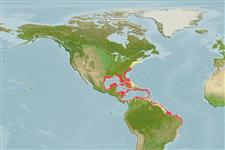
marien rifbewoner; diepte 3 - 200 m (Ref. 26938). Subtropical; 42°N - 18°S, 98°W - 34°W
Western Atlantic: Rhode Island (USA), Bermuda, and northern Gulf of Mexico southward to Brazil. Most abundant in the West Indies (Ref. 9626).
Lengte bij maturiteit / Grootte / Gewicht / Leeftijd
Maturiteit: Lm 36.0, range 30 - 42 cm
Max length : 76.0 cm FL mannelijk / geslacht onbekend; (Ref. 40637); common length : 54.0 cm TL mannelijk / geslacht onbekend; (Ref. 3815); max. gepubliceerd gewicht: 10.6 kg (Ref. 4699)
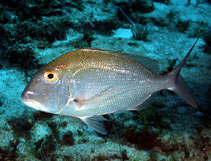
Dorsale stekels (totaal) : 12; Dorsale zachte stralen (totaal) : 12; Anale stekels: 3; Anale zachte stralen: 10. Blue line under each eye. Corner of mouth and isthmus have orange cast (Ref. 26938). An irregular row of small molariform teeth inside and toward the front of the three usual rows of molars at side of upper jaw; dorsal profile of head evenly convex and not very steep (Ref. 13442).
Body shape (shape guide): short and / or deep.
Inhabits coastal waters. Found on vegetated sand bottoms and more frequently on coral bottoms. Occasionally found at depths at least 180m (Ref. 09710) and 200 m. (Ref. 26938). Large adults are usually solitary. Feeds mainly on sea urchins, (including Diadema, Ref. 13442), crabs and mollusks. Excellent food fish (Ref. 5521).
Levenscyclus en paargedrag
Maturiteit | Voortplanting | Paaien | Eieren | Fecunditeit | Larven
Robins, C.R. and G.C. Ray, 1986. A field guide to Atlantic coast fishes of North America. Houghton Mifflin Company, Boston, U.S.A. 354 p. (Ref. 7251)
Status op de Rode Lijst van het IUCN (Ref. 130435: Version 2025-2 (Global))
Gevaar voor de mens
Reports of ciguatera poisoning (Ref. 9710)
Gebruik door de mens
Visserij: van minder commercieel belang; sportvis: ja
Tools
Speciale rapporten
Download XML
Internetbronnen
Schattingen op basis van modellen
Gewenste temperatuur (Ref.
123201): 18.6 - 27.5, mean 24.3 °C (based on 261 cells).
Fylogenetische diversiteitsindex (Ref.
82804): PD
50 = 0.5001 [Uniqueness, from 0.5 = low to 2.0 = high].
Bayesian length-weight: a=0.02570 (0.01640 - 0.04029), b=2.93 (2.80 - 3.06), in cm total length, based on LWR estimates for this species & Genus-body shape (Ref.
93245).
Trofisch niveau (Ref.
69278): 3.5 ±0.2 se; based on diet studies.
Generation time: 7.8 ( na - na) years. Estimated as median ln(3)/K based on 1
growth studies.
Weerstandsvermogen (Ref.
120179): Gemiddeld, minimale populatieverdubbelingstijd 1,4-4,4 jaar (tm=3).
Kwetsbaarheid van de visserij (Ref.
59153): High vulnerability (59 of 100).
🛈
Voedingsstoffen (Ref.
124155): Calcium = 18.2 [7.6, 38.0] mg/100g; Iron = 0.493 [0.250, 1.048] mg/100g; Protein = 20 [19, 21] %; Omega3 = 0.176 [0.096, 0.330] g/100g; Selenium = 23.3 [10.6, 48.9] μg/100g; VitaminA = 22.5 [5.2, 98.7] μg/100g; Zinc = 0.56 [0.34, 0.85] mg/100g (wet weight);