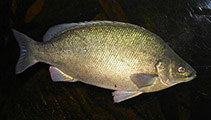
Klassifizierung / Names
Namen | Synonyme | Catalog of Fishes(Gattung, Arten) | ITIS | CoL | WoRMS | Cloffa
>
Centrarchiformes (Basses) >
Terapontidae (Grunters or tigerperches)
Etymology: Bidyanus: A local name, "bidyani" in Australia, New South Wales.
Umwelt: Milieu / Klimazone / Tiefenbereich / Verbreitungsgebiet
Ökologie
; süßwasser benthopelagisch; potamodrom (Ref. 51243); tiefenbereich 10 - ? m. Subtropical; 10°C - 30°C (Ref. 2060); 29°S - 35°S
Oceania: known only from the Murray-Darling River system, Australia. Range boundaries: Chinchilla (on the Condamine River), South Queensland, Bonshaw (on the Dumaresq River), northeastern New South Wales, Albury (on the Murray River), southeastern New South Wales, Seven Creek and Goulburn River, South Victoria.
Länge bei der ersten Reifung / Größe / Gewicht / Alter
Geschlechtsreife: Lm ?, range 34 - ? cm
Max length : 40.0 cm SL Männchen/unbestimmt; (Ref. 2906); common length : 30.0 cm SL Männchen/unbestimmt; (Ref. 44894); max. veröff. Gewicht: 1.5 kg (Ref. 5259)
Adults are found in rivers, lakes and reservoirs, preferring fast-flowing waters of rapids and races and usually forming aggregations near the surface. Usually found below rapids and weirs (Ref. 44894). Feed on aquatic insects, mollusks, earthworms and plants. Temp.: 2-37°C. Maturity: F, 3 y and 34 cm SL; M, 23.3 cm SL. Spawning: summer (Nov.-Jan., 23-30°C water temp.), effect upstream migration. Fecundity: 500000 eggs per 1.8kg. Eggs: pelagic, 2.7-2.8 mm diameter. Hatching: 30 hrs at 26-27°C. Larvae: 3.6 mm at hatching. A good angling and food fish which has been increasingly utilized as an aquaculture species in farm dams throughout Australia (Ref. 44894).
Upstream spawning migration in summer to areas behind the peak of the flood. Spawning commences late in the afternoon from the surface to a depth of about 4 m, where there is a flow over a gravel, rock rubble substrate. Considerable spawning activity happens at the water surface. A single female circles slowly to the surface with her head deep and several males participate in courtship and finally in fertilization (Ref. 2906).
Paxton, J.R., D.F. Hoese, G.R. Allen and J.E. Hanley, 1989. Pisces. Petromyzontidae to Carangidae. Zoological Catalogue of Australia, Vol. 7. Australian Government Publishing Service, Canberra, 665 p. (Ref. 7300)
IUCN Rote Liste Status (Ref. 130435: Version 2025-2 (Global))
Nutzung durch Menschen
Fischereien: kommerziell; Aquakultur: kommerziell; Sportfisch: ja
Tools
Zusatzinformationen
Download XML
Internet Quellen
Schätzungen auf der Grundlage von Modellen
Phylogenetischer Diversitätsindex (Ref.
82804): PD
50 = 0.7500 [Uniqueness, from 0.5 = low to 2.0 = high].
Bayesian length-weight: a=0.01660 (0.00632 - 0.04360), b=2.99 (2.76 - 3.22), in cm total length, based on LWR estimates for this (Sub)family-body shape (Ref.
93245).
Trophische Ebene (Ref.
69278): 3.0 ±0.34 se; based on food items.
Widerstandsfähigkeit (Ref.
120179): mittel, Verdopplung der Population dauert 1,4 - 4,4 Jahre. (tm=2-3).
Anfälligkeit der Fischerei (Ref.
59153): Moderate vulnerability (39 of 100).
🛈