>
Cypriniformes (Carps) >
Nemacheilidae (Brook loaches)
Etymology: Schistura: Greek, schizein = to divide + Greek, oura = tail; an allusion to forked caudal fins (Ref. 45335).
More on author: Bleeker.
Environnement : milieu / zone climatique / profondeur / gamme de distribution
Écologie
; eau douce benthopélagique; pH range: 6.0 - 8.0; dH range: 5 - 12. Tropical; 22°C - 24°C (Ref. 2060); 7°N - 6°N
Asia: endemic to Sri Lanka.
Taille / Poids / Âge
Maturité: Lm ? range ? - ? cm
Max length : 6.3 cm SL mâle / non sexé; (Ref. 116162)
Description synthétique
Clés d'identification | Morphologie | Morphométrie
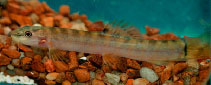
Rayons mous dorsaux (Total) : 11; Rayons mous anaux: 8. Schistura notostigma differs from all congeners from peninsular India and Sri Lanka by the
combination of the following characters: 6-7 wide, brown bars on the posterior half of the body; width of interspaces equal ½-1 times the width of the bars; black bar on caudal-fin base complete, narrower than the width of the interspaces on the body; emarginate caudal fin; incomplete lateral line ending beneath the dorsal-fin base; adpressed pelvic fin surpassing the anus; 7½ branched rays on dorsal fin; pelvic-fin origin beneath first branched dorsal-fin ray; 4-8 pre-operculo-mandibular pores; and suborbital flap in males absent (Ref. 116162).
Body shape (shape guide): elongated.
Prefers to inhabit fast flowing streams with a rock or pebble substrate (Ref. 116162). Found usually browsing among pebbles in shallow, flowing water. Can ascend steep inclines and also occurs in even the highest mountain streams (Ref. 6028).
Cycle de vie et comportement reproducteur
Maturité | Reproduction | Frai | Œufs | Fécondité | Larves
Sudasinghe, H., 2017. Schistura madhavai, a new species of hill-stream loach from Sri Lanka, with redescription of S. notostigma (Teleostei: Nemacheilidae). Zootaxa 4311(1):96-110. (Ref. 116162)
Statut dans la liste rouge de l'IUCN (Ref. 130435: Version 2025-2 (Global))
Menace pour l'homme
Harmless
Utilisations par l'homme
Pêcheries: sans intérêt; Aquarium: Commercial
Outils
Articles particuliers
Télécharger en XML
Sources Internet
Estimations basées sur des modèles
Indice de diversité phylogénétique (Réf.
82804): PD
50 = 0.5000 [Uniqueness, from 0.5 = low to 2.0 = high].
Bayesian length-weight: a=0.00708 (0.00323 - 0.01553), b=3.03 (2.86 - 3.20), in cm total length, based on LWR estimates for this Genus-body shape (Ref.
93245).
Niveau trophique (Réf.
69278): 3.0 ±0.3 se; based on size and trophs of closest relatives
Résilience (Réf.
120179): Milieu, temps minimum de doublement de population : 1,4 à 4,4 années (Preliminary K or Fecundity.).
Vulnérabilité de la pêche (Ref.
59153): Low vulnerability (10 of 100).
🛈