>
Cypriniformes (Carps) >
Gyrinocheilidae (Algae eaters)
Etymology: Gyrinocheilus: Greek, gyrinos = tadpole + Greek, cheilos = lip (Ref. 45335).
Eponymy: Étienne François Aymonier (1844–1929) was a French explorer and linguist who was the first archaeologist to make a systematic survey of the ruins of the Khmer empire in what is now parts of Cambodia, Thailand, Laos and Vietnam. [...] (Ref. 128868), visit book page.
Milieu: milieu / Klimaatzone / Diepte / verspreidingsgebied
Ecologie
; zoet water demersaal; pH range: 6.0 - 8.0; dH range: 5 - 19; potamodroom (Ref. 126106). Tropical; 25°C - 28°C (Ref. 1672)
Asia: Mekong, Chao Phraya and Meklong basins; northern Malay Peninsula.
Grootte / Gewicht / Leeftijd
Maturiteit: Lm ? range ? - ? cm
Max length : 28.0 cm SL mannelijk / geslacht onbekend; (Ref. 27732)
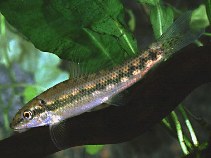
Has 9 branched dorsal rays; 36-40 lateral line scales; no dark spots on pelvic and anal fins (Ref. 27732); a small dark spot always present behind spiracle; sometimes tiny tubercles on side of head and large tubercles confined to snout (Ref. 12693).
Body shape (shape guide): elongated.
Adults are found in medium to large-sized rivers and enters flooded fields (Ref. 12975) on solid surfaces in flowing waters. Mostly herbivorous, feed largely on algae, periphyton and phytoplankton, but also take insect larvae or zooplankton. In current, they hold onto fixed objects with their sucker-like mouth. For breathing, water is pumped into the gill cavity through a small spiracle and across the gills for gas exchange. Large fish are sold in the markets, smaller ones are used to make prahoc (Ref. 12693). Aquarium keeping: needs plant feed; adults territorial; in groups of 5 or more individuals; minimum aquarium size 60 cm (Ref. 51539).
Levenscyclus en paargedrag
Maturiteit | Voortplanting | Paaien | Eieren | Fecunditeit | Larven
Rainboth, W.J., 1996. Fishes of the Cambodian Mekong. FAO species identification field guide for fishery purposes. FAO, Rome, 265 p. (Ref. 12693)
Status op de Rode Lijst van het IUCN (Ref. 130435: Version 2025-2 (Global))
Gevaar voor de mens
Harmless
Gebruik door de mens
Visserij: commercieel; Aquarium: van groot commercieel belang
Tools
Speciale rapporten
Download XML
Internetbronnen
Schattingen op basis van modellen
Fylogenetische diversiteitsindex (Ref.
82804): PD
50 = 0.7500 [Uniqueness, from 0.5 = low to 2.0 = high].
Bayesian length-weight: a=0.00389 (0.00180 - 0.00842), b=3.12 (2.94 - 3.30), in cm total length, based on all LWR estimates for this body shape (Ref.
93245).
Trofisch niveau (Ref.
69278): 2.5 ±0.25 se; based on food items.
Kwetsbaarheid van de visserij (Ref.
59153): Low vulnerability (24 of 100).
🛈