>
Cichliformes (Cichlids, convict blennies) >
Cichlidae (Cichlids) > Cichlasomatinae
Etymology: Hypsophrys: Greek, hypsi = high + Greek, ophrys = eyebrow (Ref. 45335).
More on author: Günther.
Taxonomic Remarks
Species monograph by López (1974), well illustrated. Kullander & Hartel (1997) discussed the nomenclature of Hypsophrys unimaculatus. Reviewed by Bussing (1998: 354), with key, diagnosis, geographical distribution, and figures.
Môi trường: môi trường / vùng khí hậu / Mức độ sâu / phạm vi phân phối
Sinh thái học
; nước ngọt sống nổi và đáy; pH range: 7.0 - 8.0; dH range: 9 - 20. Tropical; 23°C - 36°C (Ref. 36880)
Central America: Atlantic slope, from the San Juan drainage, including Lake Nicaragua, in Costa Rica and Nicaragua, to the Matina River drainage in Costa Rica.
Bộ gần gũi / Khối lượng (Trọng lượng) / Tuổi
Chín muồi sinh dục: Lm ? range ? - ? cm
Max length : 16.5 cm SL con đực/không giới tính; (Ref. 36377); 20.0 cm TL (female)
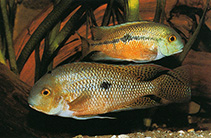
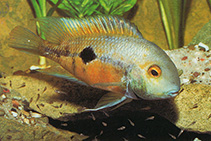
Các tia vây lưng cứng (tổng cộng) : 18 - 19; Các vây lưng mềm (tổng cộng) : 9 - 11; Tia cứng vây hậu môn: 7 - 8; Tia mềm vây hậu môn: 7 - 9. This species can be distinguished by the dark line running through the middle of the body and the large black blotch positioned midlength; head profile extremely curved with the mouth on the lower part of the head; in males, the scales have dark edges producing a reticulated pattern, their fins with many dark spots, and a red edge to the dorsal fin; both males with iridescent, greenish-blue head and with gold to copper-colored bodies (Ref. 44091).
Body shape (shape guide): fusiform / normal; Cross section: compressed.
Inhabit lakes and rivers with slow to moderate currents, between 5 to 200 m elevation (Ref. 36880). Juveniles feed on aquatic insects, while adults feed on bottom detritus, seeds and leaves. Also naturally feed on snails and other mollusks, but will accept a variety of food in captivity (Ref. 44091). Maximum length 25 cm TL (Ref. 2060).
Vòng đời và hành vi giao phối
Chín muồi sinh dục | Sự tái sinh sản | Đẻ trứng | Các trứng | Sự sinh sản | Ấu trùng
Deposits eggs in sand depressions. Produces about 200-400 non adhesive eggs with females practicing communal care during the post spawning period (an unusual behavior referred to as "creching", Ref. 44091). A group of 3 or 4 females stand guard over their combined spawns, encircling the expanded group and do not allow any intruders or predators into the rearing arena.
Kullander, S.O., 2003. Cichlidae (Cichlids). p. 605-654. In R.E. Reis, S.O. Kullander and C.J. Ferraris, Jr. (eds.) Checklist of the Freshwater Fishes of South and Central America. Porto Alegre: EDIPUCRS, Brasil. (Ref. 36377)
Tình trạng Sách đỏ IUCN (Ref. 130435: Version 2025-2 (Global))
Mối đe dọa đối với con người
Harmless
Sử dụng của con người
Các nghề cá: không ích lợi (thú vị); Bể nuôi cá: Tính thương mại
Các công cụ
Báo cáo đặc biệt
Tải xuống XML
Các nguồn internet
Ước tính dựa trên mô hình
Chỉ số đa dạng phát sinh loài (Tài liệu tham khảo
82804): PD
50 = 0.7500 [Uniqueness, from 0.5 = low to 2.0 = high].
Bayesian length-weight: a=0.02188 (0.01025 - 0.04670), b=3.05 (2.87 - 3.23), in cm total length, based on LWR estimates for this (Sub)family-body shape (Ref.
93245).
Mức dinh dưỡng (Tài liệu tham khảo
69278): 2.7 ±0.34 se; based on food items.
Thích nghi nhanh (Tài liệu tham khảo
120179): Chiêù cao, thời gian nhân đôi của chủng quần tối thiểu là dưới 15 tháng (Preliminary K or Fecundity.).
Sự dễ bị tổn thương của nghề đánh cá (Ref.
59153): Low vulnerability (10 of 100).
🛈