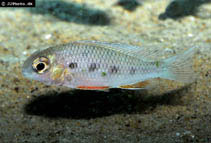
>
Cichliformes (Cichlids, convict blennies) >
Cichlidae (Cichlids) > Cichlinae
Etymology: Crenicara: Latin, crenulatus = cut, clipped + tupí, guaraní , acará = the name of a fish (Ref. 45335).
More on author: Günther.
Taxonomic Remarks
Redescription based on Peruvian material in Kullander (1986: 140), with bibliography, diagnosis, description, distribution, and illustrations. Compared with C. latruncularium in Kullander & Staeck (1990).
Entorno: milieu / zona climática / rango de profundidad / gama de distribución
Ecología
; agua dulce bentopelágico; pH range: 5.0 - 6.0; dH range: 0.10000000149012 - 10; no migratorio. Tropical; 23°C - 27°C (Ref. 42575)
South America: Amazon River basin, in Ecuador, Peru, Colombia and Brazil, in tributaries of the rivers Ucayali, Marañón, Solimões and Amazon from about the Pachitea River on the Ucayali River to about Gurupá; upper Mamoré River in Bolivia, and Madre de Dios River drainage in Peru; Essequibo River drainage in Guyana; Amapá Grande River in Amapá, Brazil.
Tamaño / Peso / Edad
Madurez: Lm ? range ? - ? cm
Max length : 12.0 cm TL macho / no sexado; (Ref. 130676)
In forest creeks and sandy river shores, often near fallen leaves or among plants. Young are all females; at about 8 months of age one female changes into a dominant male (Ref. 42575).
Ciclo vital y comportamiento de apareamiento
Madurez | Reproducción | Puesta | Huevos | Fecundidad | Larva
Attaches about 200 eggs to plants or stones; female tends the clutch. After a year the females turn into males. This corrects previous informations from Ref. 35887 and 13371.
Kullander, S.O., 1986. Cichlid fishes of the Amazon River drainage of Peru. Department of Vertebrate Zoology, Research Division, Swedish Museum of Natural History, Stockholm, Sweden, 394 p. (Ref. 9088)
Situación en la Lista Roja de la UICN (Ref. 130435: Version 2025-2 (Global))
Amenaza para el ser humano
Harmless
Usos humanos
Pesquerías: sin interés; Acuario: Comercial
Herramientas
Informes especiales
Descargar XML
Fuentes de Internet
Estimaciones basadas en modelos
Índice de diversidad filogenética (Referencia
82804): PD
50 = 0.7500 [Uniqueness, from 0.5 = low to 2.0 = high].
Bayesian length-weight: a=0.01445 (0.00665 - 0.03141), b=3.08 (2.90 - 3.26), in cm total length, based on LWR estimates for this (Sub)family-body shape (Ref.
93245).
Nivel trófico (Referencia
69278): 3.2 ±0.5 se; based on size and trophs of closest relatives
Resiliencia (Referencia
120179): Alto, población duplicada en un tiempo mínimo inferior a 15 meses (tm<1).
Vulnerabilidad pesquera (Ref.
59153): Low vulnerability (10 of 100).
🛈