分類 / 名前
共通名の | 類義語 | Catalog of Fishes(部類, 種) | ITIS | CoL | WoRMS | Cloffa
>
Cypriniformes (Carps) >
Cyprinidae (Minnows or carps) > Smiliogastrinae
Etymology: Enteromius: Greek, enteron = intestine + Greek, myo, mys = muscle (Ref. 45335).
環境:環境 / 気候帯 / 深さの範囲 / 分布範囲
生態学
; 新鮮な水 底生の漂泳性. Subtropical; 24°S - 33°S
Africa: endemic to the eastern Cape Fold Ecoregion in South Africa, where it is distributed from the Krom to the Great Fish river system (Ref. 52193, 122070). Specimens identified as Enteromius pallidus from tributaries of the Orange-Vaal, Tugela, Mfolozi, Pongolo, Incomati and Limpopo rivers (Ref. 7248, 13332) are not related and should be treated as misidentifications (Ref. 122070).
初回成熟時の長さ / サイズ / 重さ / 年齢
成熟: Lm ?, range 4 - ? cm
Max length : 7.0 cm SL オス/雌雄の選別がない; (Ref. 52193)
簡単な記述
検索表 | 形態学 | 形態計測学
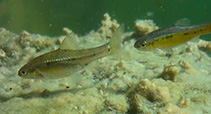
背面の脊椎 (合計) : 0; 背鰭 (合計) : 10; 肛門の骨: 0; 臀鰭: 8. Diagnosis: Enteromius pallidus can be identified by the slightly convex dorsal surface; posterior barbel 2.0 to 3.0 times the length of anterior barbel; a slightly prominent snout; an incomplete lateral line; deep translucent light brown to golden sheen with the presence of irregular and scattered spots in mature adults; and the presence of 3-7 bold spots above the lateral line in juveniles and subadults (Ref. 122070). This species belongs to the group of Enteromius species in southern Africa that is characterised by a simple and flexible unbranched primary dorsal fin ray (Ref. 122070). It is distinguished from E. amatolicus, E. anoplus, E. annectens, E. toppini and E. radiatus by possession of two pairs of prominent and long barbels vs. single pair and/or minute oral barbels in other species; it is distinguished from E. lineomaculatus, E. viviparus and E. unitaeniatus by absence of distinct chevron markings on the lateral line vs. presence of conspicuous chevron markings on the lateral line in the other three species, and from E. bifrenatus by absence of a distinct lateral stripe and absence of black tubular markings around lateral line pores vs. presence in E. bifrenatus; it is distinguished from E. anoplus, E. amatolicus, E. annectens, E. unitaeniatus, E. bifrenatus, E. gurneyi, E. motebensis, E. radiatus, E. toppini, E. treurensis and E. viviparus by the presence of scattered black spots on the body, particularly in juveniles vs. absence of scattered black spots in the other species (Ref. 122070). Lateral pigmentation pattern of E. pallidus is closely similar to that of E. brevipinnis and E. neefi, but it is distinguished from these two species by having an incomplete lateral line vs. complete lateral line in both E. neefi and E. brevipinnis; it is further separated from E. neefi by absence of wavy lines along the scale rows vs. presence of conspicuous wavy lines along the scale rows in E. neefi, and from E. brevipinnis by lack of black pigmentation around the borders of the scales vs. presence of distinct black pigmentation around the scales in E. brevipinnis, giving a mesh-like pattern on the lateral side of the fish (Ref. 122070).
Body shape (shape guide): fusiform / normal; Cross section: compressed.
Inhabits pools in clear, rocky streams often streams with emergent marginal vegetation (Ref. 7248, 52193). Spawning is likely to begin in summer, from October to November (Ref. 122070); breeding pairs lay eggs in vegetation (Ref. 7248, 52193).
ライフサイクルと交尾行動
成熟 | 繁殖 | 放精 | 卵 | 生産力 | 幼生
Skelton, P.H., 2001. A complete guide to the freshwater fishes of southern Africa. Cape Town (South Africa): Struik Publishers, 395 p. (Ref. 52193)
IUCNのレッドリストの状況は (Ref. 130435: Version 2025-2 (Global))
人間の用途
水産業: 商業; 水族館・水槽: 商業
用具
特記事項
XMLをダウンロードして下さい
インターネットの情報源
モデルに基づく推定値
系統多様性指数 (参照
82804): PD
50 = 0.5000 [Uniqueness, from 0.5 = low to 2.0 = high].
Bayesian length-weight: a=0.00603 (0.00282 - 0.01286), b=3.06 (2.87 - 3.25), in cm total length, based on LWR estimates for this (Sub)family-body shape (Ref.
93245).
栄養段階 (参照
69278): 3.0 ±0.3 se; based on size and trophs of closest relatives
回復力 (参照
120179): 高い, 15か月以下の倍増期間の最小個体群 (Preliminary K or Fecundity.).
漁業の脆弱性 (Ref.
59153): Low vulnerability (10 of 100).
🛈