>
Carangaria/misc (Various families in series Carangaria) >
Sphyraenidae (Barracudas)
Etymology: Sphyraena: Greek, sphyraina, -es = the name of a fish (Ref. 45335).
More on author: Poey.
Umwelt: Milieu / Klimazone / Tiefenbereich / Verbreitungsgebiet
Ökologie
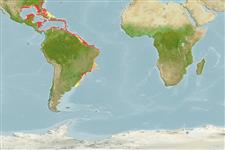
seewasser riff-verbunden; tiefenbereich 1 - 65 m (Ref. 9626). Tropical; 33°N - 35°S, 97°W - 34°W
Western Atlantic: Bermuda, Florida (USA), and the Bahamas to Uruguay.
Größe / Gewicht / Alter
Geschlechtsreife: Lm ? range ? - ? cm
Max length : 61.0 cm FL Männchen/unbestimmt; (Ref. 40637); common length : 36.0 cm TL Männchen/unbestimmt; (Ref. 3819); max. veröff. Gewicht: 1.1 kg (Ref. 40637)
Rückenflossenstacheln (insgesamt) : 6; Rückenflossenweichstrahlen (insgesamt) : 9; Afterflossenstacheln: 2; Afterflossenweichstrahlen: 9.
Body shape (shape guide): elongated.
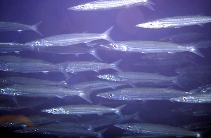
Inhabits coastal waters. Found in rocky or coral reefs (Ref. 9710). More abundant over muddy bottoms. Juveniles are encountered in seagrass beds (Ref. 9626). Often occurs in large schools, sometimes near the surface (Ref. 9626). Marketed fresh and frozen.
Lebenszyklus und Paarungsverhalten
Geschlechtsreife | Fortpflanzung | Ablaichen | Eier | Fruchtbarkeit | Larven
Robins, C.R. and G.C. Ray, 1986. A field guide to Atlantic coast fishes of North America. Houghton Mifflin Company, Boston, U.S.A. 354 p. (Ref. 7251)
IUCN Rote Liste Status (Ref. 130435: Version 2025-2 (Global))
Bedrohung für Menschen
Reports of ciguatera poisoning (Ref. 30911)
Nutzung durch Menschen
Fischereien: weniger kommerziell; Sportfisch: ja
Tools
Zusatzinformationen
Download XML
Internet Quellen
Schätzungen auf der Grundlage von Modellen
Bevorzugte Temperatur (Ref.
123201): 22.7 - 28, mean 26.1 °C (based on 402 cells).
Phylogenetischer Diversitätsindex (Ref.
82804): PD
50 = 0.5000 [Uniqueness, from 0.5 = low to 2.0 = high].
Bayesian length-weight: a=0.00603 (0.00306 - 0.01186), b=2.93 (2.76 - 3.10), in cm total length, based on LWR estimates for this species & Genus-body shape (Ref.
93245).
Trophische Ebene (Ref.
69278): 4.2 ±0.3 se; based on diet studies.
Widerstandsfähigkeit (Ref.
120179): mittel, Verdopplung der Population dauert 1,4 - 4,4 Jahre. (Preliminary K or Fecundity.).
Anfälligkeit der Fischerei (Ref.
59153): Moderate to high vulnerability (47 of 100).
🛈
Nährstoffe (Ref.
124155): Calcium = 20.1 [9.3, 52.6] mg/100g; Iron = 0.308 [0.144, 0.652] mg/100g; Protein = 20 [18, 22] %; Omega3 = 0.0891 [, ] g/100g; Selenium = 32.4 [14.2, 83.5] μg/100g; VitaminA = 52.8 [11.7, 256.5] μg/100g; Zinc = 0.519 [0.325, 0.894] mg/100g (wet weight);