分类 / 名称
俗名 | 同种异名 | Catalog of Fishes(属, 种) | ITIS | CoL | WoRMS | Cloffa
Teleostei >
Characiformes (Characins) >
Ctenoluciidae (Pike-characids)
Etymology: Boulengerella: From George Albert Boulenger (1858-1937); he revised the works of Günther about Percoidei (Ref. 45335).
Eponymy: George Albert Boulenger (1858–1937) was a Belgian-British zoologist at the British Museum, London. [...] (Ref. 128868), visit book page.
More on author: Cuvier.
Taxonomic Remarks
Redescribed with synonymy in Vari (1995:69).
环境:氛围 / 气候带 / 深度上下限 / 分布范围
生态学
; 淡水 大洋性; pH range: 6.0 - 7.2; dH range: ? - 15. 熱帶; 23°C - 27°C (Ref. 2060)
South America: Rio Amazonas and Río Orinoco basins.
南美洲: Rio Amazonas 與 Rio 奧里諾科河流域。
大小 / 重量 / 年龄
成熟度: Lm ? range ? - ? cm
Max length : 43.0 cm SL 雄鱼/尚未辨别雌雄; (Ref. 125971); 最大体重: 640.00 g (Ref. 125971)
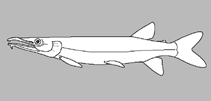
背棘 (总数) : 0; 背的软条 (总数) : 10 - 11; 臀棘: 0; 臀鳍软条: 11; 脊椎骨: 45 - 46. The location of the dorsal fin base distinctly anterior to the vertical through the anal fin origin distinguishes this species from all ctenoluciids except B. cuvieri and B. xyrekes, from which it can be distinguished by the dark pigmentation (spot) on the caudal fin and the pigmentation on the body.
背鳍基底的地点明显地位于前垂直的经过臀鳍起源除了 B. cuvieri 与 B. xyrekes 以外将此种与所有的 ctenoluciids 区分开, 从它在尾鳍上鉴别的特徵是深色的颜色 (斑点) 而且在身体上鉴别的特徵是颜色。
生命周期和交配行为
成熟度 | 繁殖 | 产卵场 | 卵 | 孕卵数 | 仔鱼
南美洲: Rio Amazonas 與 Rio 奧里諾科河流域。
Vari, R.P., 1995. The Neotropical fish family Ctenoluciidae (Teleostei: Ostariophysi: Characiformes): supra and intrafamilial phylogenetic relationships, with a revisionary study. Smithson. Contri. Zool. No. 564, 97 p. (Ref. 13118)
世界自然保护联盟红皮书 (Ref. 130435: Version 2025-2 (Global))
人类利用
渔业: 商业性; 水族馆: 公众的水族馆
工具
特别资料
下载 XML
网络资源
基于模型的估算
系统发育多样性指数 (参考文献
82804): PD
50 = 0.5391 [Uniqueness, from 0.5 = low to 2.0 = high].
Bayesian length-weight: a=0.00372 (0.00189 - 0.00731), b=3.17 (2.99 - 3.35), in cm total length, based on LWR estimates for this species & (Sub)family-body (Ref.
93245).
营养阶层 (参考文献
69278): 4.5 ±0.80 se; based on food items.
渔业脆弱性 (Ref.
59153): Moderate vulnerability (41 of 100).
🛈