>
Tetraodontiformes (Puffers and filefishes) >
Tetraodontidae (Puffers) > Tetraodontinae
Etymology: Sphoeroides: Greek, sphaira = ball + Greek, suffix, oides = similar to (Ref. 45335).
Eponymy: Lorentz Spengler (1720–1807) was a zoologist employed by Det Kongelige Danske Kunstkammer, Copenhagen, as Assistant to the Keeper (1765). [...] (Ref. 128868), visit book page.
More on author: Bloch.
Entorno: milieu / zona climática / rango de profundidad / gama de distribución
Ecología
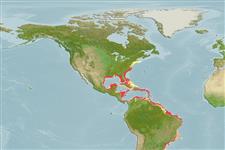
marino; salobre asociado a arrecife; rango de profundidad 2 - 70 m (Ref. 26999). Subtropical; 43°N - 30°S, 98°W - 34°W
Western Atlantic: Massachusetts, USA to Santa Catarina, Brazil (Ref. 57756). Replaced by Sphoeroides marmoratus in the eastern Atlantic (P. Wirtz, pers. comm. 10/04).
Tamaño / Peso / Edad
Madurez: Lm ? range ? - ? cm
Max length : 30.0 cm TL macho / no sexado; (Ref. 26999); common length : 12.0 cm TL macho / no sexado; (Ref. 3821)
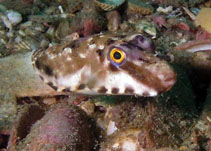
Radios blandos dorsales (total) : 9. 11-14 sharply defined round black spots on head and lower side of body. The numerous tan lappers on the rear part of the body and distinct spots along the lower side make it unmistakable (Ref. 26938).
Body shape (shape guide): fusiform / normal.
Abundant in all inshore habitats where there is adequate cover, such as seagrass beds and reef flats. Feeds on mollusks, crustaceans and echinoderms (Ref. 36453), also on worms and zooplankton larvae (Ref. 131040). Generally common (Ref. 9710). Traded as an aquarium fish at Ceará, Brazil (Ref. 49392).
Ciclo vital y comportamiento de apareamiento
Madurez | Reproducción | Puesta | Huevos | Fecundidad | Larva
Robins, C.R. and G.C. Ray, 1986. A field guide to Atlantic coast fishes of North America. Houghton Mifflin Company, Boston, U.S.A. 354 p. (Ref. 7251)
Situación en la Lista Roja de la UICN (Ref. 130435: Version 2025-2 (Global))
Amenaza para el ser humano
Poisonous to eat (Ref. 3821)
Usos humanos
Pesquerías: comercial; Acuario: Comercial
Herramientas
Informes especiales
Descargar XML
Fuentes de Internet
Estimaciones basadas en modelos
Temperatura preferida (Referencia
123201): 22.5 - 28, mean 25 °C (based on 472 cells).
Índice de diversidad filogenética (Referencia
82804): PD
50 = 0.5000 [Uniqueness, from 0.5 = low to 2.0 = high].
Bayesian length-weight: a=0.01738 (0.01354 - 0.02230), b=2.90 (2.84 - 2.96), in cm total length, based on LWR estimates for this species (Ref.
93245).
Nivel trófico (Referencia
69278): 3.3 ±0.2 se; based on diet studies.
Resiliencia (Referencia
120179): Alto, población duplicada en un tiempo mínimo inferior a 15 meses (Preliminary K or Fecundity.).
Vulnerabilidad pesquera (Ref.
59153): Low vulnerability (20 of 100).
🛈
Nutrientes (Ref.
124155): Calcium = 32.6 [10.8, 107.5] mg/100g; Iron = 0.68 [0.34, 1.43] mg/100g; Protein = 19.7 [17.5, 21.9] %; Omega3 = 0.262 [0.123, 0.509] g/100g; Selenium = 15.9 [7.1, 34.3] μg/100g; VitaminA = 42.4 [13.0, 139.6] μg/100g; Zinc = 0.993 [0.654, 1.519] mg/100g (wet weight);