>
Blenniiformes (Blennies) >
Dactyloscopidae (Sand stargazers)
Etymology: Gillellus: Theodore Nicolas Gill (1837-1914) researcher of abyssal fishes and systematics (Ref. 45335); healae: Named after Elizabeth Heal in partial recognition for her years of efficient and willing assistance to Dr. C.E. Dawson (Ref. 27742).
Eponymy: Elizabeth Heal was Dawson’s assistant. [...] (Ref. 128868), visit book page.
Miljö: miljö / Klimatzon / djupintervall / distributionsområde
Ekologi
marina bottenlevande; djupintervall 21 - 73 m (Ref. 27742). Tropical; 33°N - 12°N
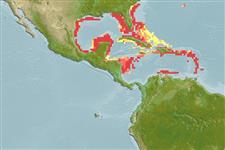
Western Atlantic: South Carolina and northeastern Gulf of Mexico to Florida Keys in USA, and also Aruba.
Storlek / Vikt / Ålder
Könsmognad: Lm ? range ? - ? cm
Max length : 7.5 cm TL hane/ej könsbestämd; (Ref. 7251)
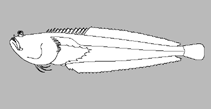
Taggstrålar i ryggfenan (totalt) : 11 - 15; Mjukstrålar i ryggfenan (totalt) : 27 - 29; Taggstrålar i analfenan: 2. Common amongst Dactyloscopidae: Small, elongate fishes. Head usually broad and deep, body tapering and compressed behind. Eyes on top of head, often protrusible; mouth moderate to large, oblique to vertical; jaw teeth minute, in 2 or more series; no teeth on roof of mouth (vomer and palatines). Opercular opening large, gill membrane free from isthmus; opercles membranous, large, usually overlapping on underside of head, typically fringed above with 2 to 24 fleshy fimbriae. Dorsal fin continuous, with an isolated or semi-isolated anterior finlet, or with 1 to 5 separate anterior rays; dorsal-fin spines 7 to 23; anal-fin spines 2; dorsal and anal fins free or united to caudal fin by fragile membranes; pectoral fins broad-based, usually enlarged in mature males; caudal-fin rays simple or branched; pelvic fins under throat (insertion anterior to pectoral-fin base), with 1 spine and 3 thickened segmented rays; all other rays simple. Head and venter naked, body elsewhere with large cycloid scales (smooth to touch); lateral line high anteriorly, deflecting ventrally behind pectoral fin to continue along middle of side to caudal-fin base where terminal lateral-line scale bears ventrally directed canal. Body coloration, variably pale to strongly pigmented with white, brown, or reddish; some forms with characteristic saddle-like bars crossing back; others plain, mottled, or with indications of lateral stripes. Species distinguished by: dorsal-fin origin on nape; fin with an isolated or semi-isolated anterior finlet. Segmented caudal-fin rays usually 10; arched lateral-line scales 22 to 33. First preopercular canal not branched, with a single distal pore. Upper lip without fimbriae (Ref.52855).
Body shape (shape guide): elongated.
Burrows in soft sandy bottom, where it waits for prey, with only the eyes, nose and mouth protruding.
Livscykel och parningsbeteende
Könsmognad | Reproduktion | Lek | Ägg | Fekunditet | Larver
Robins, C.R., R.M. Bailey, C.E. Bond, J.R. Brooker, E.A. Lachner, R.N. Lea and W.B. Scott, 1991. Common and scientific names of fishes from the United States and Canada. Am. Fish. Soc. Spec. Publ. (20):183 p. (Ref. 3814)
Status på IUCN:s rödlista (Ref. 130435: Version 2025-2 (Global))
Hot mot människor
Harmless
Mänskliga användningsområden
Verktyg
Särskilda rapporter
Ladda ner XML
Internet-källor
Uppskattningar baserade på modeller
Önskad temperatur (Ref.
123201): 22 - 27.6, mean 24.8 °C (based on 54 cells).
Index för fylogenetisk mångfald (Ref.
82804): PD
50 = 0.5010 [Uniqueness, from 0.5 = low to 2.0 = high].
Bayesian length-weight: a=0.00389 (0.00180 - 0.00842), b=3.12 (2.94 - 3.30), in cm total length, based on all LWR estimates for this body shape (Ref.
93245).
Trofisk nivå (Ref.
69278): 4.0 ±0.61 se; based on food items.
Sårbarhet i fisket (Ref.
59153): Low vulnerability (10 of 100).
🛈