>
Ovalentaria/misc (Various families in series Ovalentaria) >
Pomacentridae (Damselfishes) > Pomacentrinae
Etymology: Neoglyphidodon: Greek, para = the side of + Greek, glyphis = carved + Greek, odous = teeth.
Eponymy: Norbert J Cross is an Honorary Associate of the Western Australian Museum (Perth), where Allen works, and with whom he has co-authored papers such as: Description of Five New Rainbowfishes (Melanotaeniidae) From New Guinea (1980) and the book: [...] (Ref. 128868), visit book page.
Entorno: milieu / zona climática / rango de profundidad / gama de distribución
Ecología
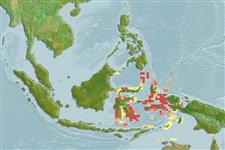
marino asociado a arrecife; no migratorio; rango de profundidad 1 - 12 m (Ref. 90102). Tropical; 5°N - 11°S, 119°E - 135°E
Western Central Pacific: known only from Sulawesi and the Moluccas.
Tamaño / Peso / Edad
Madurez: Lm ? range ? - ? cm
Max length : 10.0 cm SL macho / no sexado; (Ref. 7247)
Descripción breve
Claves de identificación | Morfología | Morfometría
Espinas dorsales (total) : 13; Radios blandos dorsales (total) : 14 - 16; Espinas anales: 2; Radios blandos anales: 13 - 14.
Body shape (shape guide): short and / or deep; Cross section: compressed.
Adults inhabit shallow gutters of rocky areas or coral reefs of protected bays and lagoons. Solitary and shy (Ref. 9710). Often swimming near the surface (Ref. 48636). Oviparous, distinct pairing during breeding (Ref. 205). Eggs are demersal and adhere to the substrate (Ref. 205). Males guard and aerate the eggs (Ref. 205). Diurnal species (Ref. 113699).
Ciclo vital y comportamiento de apareamiento
Madurez | Reproducción | Puesta | Huevos | Fecundidad | Larva
Oviparous, distinct pairing during breeding (Ref. 205). Eggs are demersal and adhere to the substrate (Ref. 205). Males guard and aerate the eggs (Ref. 205).
Allen, G.R., 1991. Damselfishes of the world. Mergus Publishers, Melle, Germany. 271 p. (Ref. 7247)
Situación en la Lista Roja de la UICN (Ref. 130435: Version 2025-2 (Global))
Amenaza para el ser humano
Harmless
Usos humanos
Herramientas
Informes especiales
Descargar XML
Fuentes de Internet
Estimaciones basadas en modelos
Temperatura preferida (Referencia
123201): 28.4 - 29.2, mean 28.8 °C (based on 140 cells).
Índice de diversidad filogenética (Referencia
82804): PD
50 = 0.5020 [Uniqueness, from 0.5 = low to 2.0 = high].
Bayesian length-weight: a=0.02344 (0.01149 - 0.04783), b=2.98 (2.80 - 3.16), in cm total length, based on LWR estimates for this (Sub)family-body shape (Ref.
93245).
Nivel trófico (Referencia
69278): 2.8 ±0.3 se; based on size and trophs of closest relatives
Resiliencia (Referencia
120179): Alto, población duplicada en un tiempo mínimo inferior a 15 meses (Preliminary K or Fecundity.).
Vulnerabilidad pesquera (Ref.
59153): Low vulnerability (10 of 100).
🛈
Nutrientes (Ref.
124155): Calcium = 113 [56, 183] mg/100g; Iron = 0.725 [0.421, 1.212] mg/100g; Protein = 18.5 [17.3, 19.6] %; Omega3 = 0.115 [0.067, 0.193] g/100g; Selenium = 18.3 [10.1, 36.3] μg/100g; VitaminA = 113 [33, 367] μg/100g; Zinc = 1.6 [1.1, 2.3] mg/100g (wet weight);