>
Scombriformes (Mackerels) >
Scombridae (Mackerels, tunas, bonitos) > Scombrinae
Etymology: Scomberomorus: Latin, scomber = mackerel + Greek, moros = silly, stupid (Ref. 45335).
More on author: Cuvier.
Miljö: miljö / Klimatzon / djupintervall / distributionsområde
Ekologi
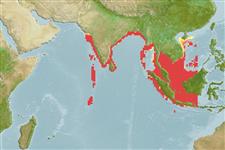
marina pelagic-neritic; havsvandrande (Ref. 51243). Tropical; 24°N - 11°S, 70°E - 115°E (Ref. 168)
Indo-West Pacific: west coast of India and Sri Lanka eastward to Thailand, Malaysia and Java (Ref. 9684). Does not extend further out in the East Indies (Ref. 9684).
Längd vid första mognad / Storlek / Vikt / Ålder
Könsmognad: Lm 70.0 range ? - ? cm
Max length : 94.0 cm FL hane/ej könsbestämd; (Ref. 168); 98.0 cm (female); common length : 70.0 cm FL hane/ej könsbestämd; (Ref. 9684)
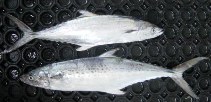
Taggstrålar i ryggfenan (totalt) : 15 - 18; Mjukstrålar i ryggfenan (totalt) : 15 - 19; Mjukstrålar i analfenan: 17 - 22; Ryggkotor: 44 - 46. A unique pigment pattern of short lines on the sides which distinguishes from all other species of Scomberomorus; maxilla with the posterior end greatly expanded; parasphenoid wide (Ref. 10996). Interpelvic process small and bifid. Lateral line without auxiliary branches anteriorly, running almost straight below second dorsal finlet then slightly bent downward toward keel of caudal peduncle. Intestine with 2 folds and 3 limbs. Swim bladder absent. Body covered with small scales. First dorsal fin black posteriorly.
Body shape (shape guide): fusiform / normal; Cross section: oval.
Unlike S. commerson and S. guttatus, S. lineolatus is not encountered in very turbid waters or much reduced salinity. Feeds primarily on fishes. Also taken with midwater trawls, purse seines and by trolling (Ref. 9684). Taken from Oct.-Nov. along the Thai coast, Indian Ocean; in Malaysia Nov.-Feb. in the west coast, Mar.-Jul. in the south, Feb.-Mar. and Aug.-Nov. in the east; in India from May-Sept. with other seerfishes. Marketed mainly fresh; also dried-salted (Ref. 9684). Also consumed as spicy fishballs.
Collette, B.B. and C.E. Nauen, 1983. FAO Species Catalogue. Vol. 2. Scombrids of the world. An annotated and illustrated catalogue of tunas, mackerels, bonitos and related species known to date. Rome: FAO. FAO Fish. Synop. 125(2):137 p. (Ref. 168)
Status på IUCN:s rödlista (Ref. 130435: Version 2025-2 (Global))
Hot mot människor
Harmless
Mänskliga användningsområden
Fiskeri: kommersiell; sportfisk: ja
Verktyg
Särskilda rapporter
Ladda ner XML
Internet-källor
Uppskattningar baserade på modeller
Önskad temperatur (Ref.
123201): 23.8 - 28.6, mean 27.7 °C (based on 595 cells).
Index för fylogenetisk mångfald (Ref.
82804): PD
50 = 0.5000 [Uniqueness, from 0.5 = low to 2.0 = high].
Bayesian length-weight: a=0.00692 (0.00371 - 0.01290), b=2.99 (2.84 - 3.14), in cm total length, based on LWR estimates for this species & Genus-body shape (Ref.
93245).
Trofisk nivå (Ref.
69278): 4.5 ±0.80 se; based on food items.
Resiliens (Ref.
120179): Mellan, lägsta populationsfördubblingstid 1,4-4,4 år (K=0.18-0.22; tm=2; Fec=560,000).
Sårbarhet i fisket (Ref.
59153): Very high vulnerability (79 of 100).
🛈
Sårbarhet för klimatet (Ref.
125649): Very high vulnerability (82 of 100).
🛈
Näringsämnen (Ref.
124155): Calcium = 31.6 [14.0, 106.5] mg/100g; Iron = 0.806 [0.360, 1.933] mg/100g; Protein = 20.6 [19.3, 21.8] %; Omega3 = 0.267 [0.165, 0.431] g/100g; Selenium = 58.3 [21.7, 190.0] μg/100g; VitaminA = 25.5 [6.3, 113.2] μg/100g; Zinc = 0.659 [0.434, 1.038] mg/100g (wet weight);