Élasmobranches (requins et raies) (sharks and rays) >
Rajiformes (Skates and rays) >
Rajidae (Skates)
Etymology: Leucoraja: Greek, leykos = white + Latin, raja = a fish, Raja sp. (Ref. 45335).
Eponymy: Dr Samuel Trevor Walton Garman (1843–1927) was an American naturalist, most noted as an ichthyologist and herpetologist. [...] (Ref. 128868), visit book page.
More on author: Whitley.
Environnement : milieu / zone climatique / profondeur / gamme de distribution
Écologie
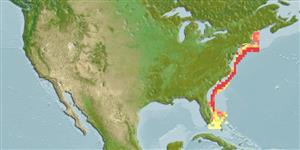
marin bathydémersal; océanodrome (Ref. 51243); profondeur 33 - 530 m (Ref. 106604). Subtropical; 9°C - 17°C (Ref. 41312); 44°N - 24°N, 81°W - 69°W
Western Atlantic.
Leucoraja garmani contains two valid subspecies: Leucoraja garmani caribbaea. (McEachran, 1977) and Leucoraja garmani virginica
(McEachran, 1977); here considered as junior synonyms.
Longueur à la première maturité / Taille / Poids / Âge
Maturité: Lm ?, range 34 - ? cm
Max length : 57.0 cm TL mâle / non sexé; (Ref. 106604)
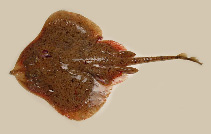
Rows of spines along back and sides of tail. Tail rather long. Conspicuous dark rosettes on upper surface of disk in young and adults. Axil of pelvic fin to 1st dorsal fin greater than from axil of pelvic fin to eye (Ref. 7251). Upper surface pale buff or brown freckled with small spots, darker or paler. Lower surface white or pale yellow (Ref. 6902).
Body shape (shape guide): other.
Occur mostly on outer edge of continental shelf and upper part of continental slope (Ref. 7251). Known salinities at which it has been taken 33.8 off Block Island to 35.3 off Chesapeake bay (Ref. 6902). Feed mostly on decapod crustaceans and to a lesser extent on amphipods, polychaetes, squids and fishes. Oviparous (Ref. 50449). Distinct pairing with embrace. Young may tend to follow large objects, such as their mother (Ref. 205). Eggs are oblong capsules with stiff pointed horns at the corners deposited in sandy or muddy flats (Ref. 205). Egg capsules are 3.7-5.4 cm long and 2.6-3.0 cm wide (Ref. 41301, 41298). Marketed fresh and salted (Ref. 3824).
Cycle de vie et comportement reproducteur
Maturité | Reproduction | Frai | Œufs | Fécondité | Larves
Oviparous, paired eggs are laid. Embryos feed solely on yolk (Ref. 50449). Distinct pairing with embrace. Young may tend to follow large objects, such as their mother (Ref. 205).
McEachran, J.D. and K.A. Dunn, 1998. Phylogenetic analysis of skates, a morphologically conservative clade of elasmobranchs (Chondrichthyes: Rajidae). Copeia 1998(2):271-290. (Ref. 27314)
Statut dans la liste rouge de l'IUCN (Ref. 130435: Version 2025-2 (Global))
Menace pour l'homme
Harmless
Utilisations par l'homme
Pêcheries: intérêt commercial mineur; appât: occasionally
Outils
Articles particuliers
Télécharger en XML
Sources Internet
Estimations basées sur des modèles
Température préférée (Réf.
123201): 10 - 23.2, mean 18.3 °C (based on 20 cells).
Indice de diversité phylogénétique (Réf.
82804): PD
50 = 0.5000 [Uniqueness, from 0.5 = low to 2.0 = high].
Bayesian length-weight: a=0.00251 (0.00172 - 0.00367), b=3.17 (3.06 - 3.28), in cm total length, based on LWR estimates for this species & Genus-body shape (Ref.
93245).
Niveau trophique (Réf.
69278): 3.6 ±0.0 se; based on diet studies.
Résilience (Réf.
120179): Faible, temps minimum de doublement de population : 4,5 à 14 années (Fec assumed to be <100).
Vulnérabilité de la pêche (Ref.
59153): Moderate vulnerability (43 of 100).
🛈
Nutriments (Ref.
124155): Calcium = 7.79 [0.85, 125.68] mg/100g; Iron = 0.442 [0.039, 5.145] mg/100g; Protein = 16.8 [14.7, 18.9] %; Omega3 = 0.328 [0.129, 0.815] g/100g; Selenium = 15.4 [2.5, 74.0] μg/100g; VitaminA = 43.3 [3.2, 514.0] μg/100g; Zinc = 0.701 [0.049, 8.046] mg/100g (wet weight);