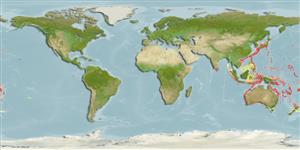
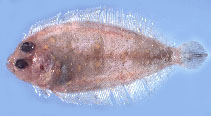
Ambiente: milieu / zona climatica / distribuzione batimetrica / gamma di distribuzione
Ecologia
marino batidemersale; distribuzione batimetrica 200 - 400 m (Ref. 9824). Deep-water
Indo-West Pacific: southern Japan (Ref. 559), southern Indonesia to northwest Australia, and New Caledonia.
Dimensione / Peso / Età
Maturità: Lm ? range ? - ? cm
Max length : 20.3 cm SL maschio/sesso non determinato; (Ref. 9824)
Spine dorsali (totale) : 0; Raggi dorsali molli (totale) : 104 - 113; Spine anali: 0; Raggi anali molli: 83 - 90; Vertebre: 31 - 32. Caudal fin darkened on middle rays (Ref 42535). Related to P. coarctatus, but differs from it in having a small number of scales on the lateral line, larger eye, its diameter 3.5 times in head length, no dark blotches on lateral line and no dots along upper margin of upper eye.
Body shape (shape guide): short and / or deep; Cross section: compressed.
Feeds on fishes, shrimps, and other small benthic animals (Ref. 9824). Marketed fresh or dried (Ref. 9824).
Ciclo vitale e comportamento di accoppiamento
Maturità | Riproduzione | Deposizione | Uova | Fecondità | Larve
Masuda, H., K. Amaoka, C. Araga, T. Uyeno and T. Yoshino, 1984. The fishes of the Japanese Archipelago. Vol. 1. Tokai University Press, Tokyo, Japan. 437 p. (text). (Ref. 559)
Stato della Lista Rossa IUCN (Ref. 130435: Version 2025-2 (Global))
Minaccia per l'uomo
Harmless
Usi umani
Pesca: commerciale
Strumenti
Rapporti speciali
Scarica XML
Fonti Internet
Stime basate su modelli
Temperatura preferita (Fonte Biblio.
123201): 3.3 - 18.9, mean 13.4 °C (based on 64 cells).
Indice di diversità filogenetica (Fonte Biblio.
82804): PD
50 = 0.5010 [Uniqueness, from 0.5 = low to 2.0 = high].
Bayesian length-weight: a=0.00912 (0.00412 - 0.02018), b=3.05 (2.87 - 3.23), in cm total length, based on LWR estimates for this (Sub)family-body shape (Ref.
93245).
Livello trofico (Fonte Biblio.
69278): 3.9 ±0.60 se; based on food items.
Resilienza (Fonte Biblio.
120179): Medio, tempo minimo di raddoppiamento della popolazione 1.4 - 4.4 anni (Assuming tmax>3).
Vulnerabilità della pesca (Ref.
59153): Low vulnerability (15 of 100).
🛈