Elasmobranchii (tubarões e raias) (sharks and rays) >
Rhinopristiformes (Shovelnose rays) >
Glaucostegidae (Giant guitarfishes)
Eponymy: André Thouin (1746–1824) was a French botanist and a colleague of Lacépède’s at Le Jardin des Plantes (Muséum Nationale d’Histoire Naturelle), Paris. [...] (Ref. 128868), visit book page.
Meio ambiente: milieu / Zona climática / intervalo de profundidade / faixa de distribuição
Ecologia
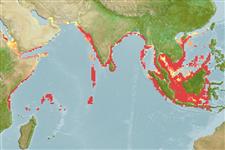
marinhas bentopelágico; intervalo de profundidade ? - 60 m (Ref. 114953). Tropical; 28°N - 10°S, 33°E - 120°E (Ref. 114953)
Indo-West Pacific: Red Sea, India (including Sri Lanka) to Indonesia, north to Japan (Ref. 114953). Australian and old records from the Mediterranean Sea and Suriname need confirmation.
Tamanho / Peso / Idade
Maturidade: Lm ? range ? - ? cm
Max length : 300 cm TL macho/indeterminado; (Ref. 58048)
Found inshore (Ref. 9909) and offshore (Ref. 58784). A carnivorous fish that feeds on large shellfishes (Ref. 58784). Ovoviviparous (Ref. 50449). Biology little known (Ref. 9909). Caught occasionally by demersal tangle net fisheries operating throughout the area. Utilized for its meat, find (both very high value), skin and cartilage (Ref.58048). Marketed fresh and probably dried-salted (Ref. 9909).
Ciclo de vida ou comportamento de acasalamento
Maturidade | Reprodução | Desova | Ovos | Fecundidade | Larvas
Exhibit ovoviparity (aplacental viviparity), with embryos feeding initially on yolk, then receiving additional nourishment from the mother by indirect absorption of uterine fluid enriched with mucus, fat or protein through specialised structures (Ref. 50449).
Compagno, L.J.V., 1999. Checklist of living elasmobranchs. p. 471-498. In W.C. Hamlett (ed.) Sharks, skates, and rays: the biology of elasmobranch fishes. Johns Hopkins University Press, Maryland. (Ref. 35766)
Status na Lista Vermelha da UICN (Ref. 130435: Version 2025-2 (Global))
Ameaça para os humanos
Harmless
Uso pelos humanos
Pescarias: espécies comerciais
Ferramentas
Relatórios especiais
Baixar XML
Fontes da internet
Estimativas baseadas em modelos
Temperatura preferida (Ref.
123201): 24.8 - 29.1, mean 28.1 °C (based on 1958 cells).
Índice de diversidade filogenética (Ref.
82804): PD
50 = 0.5020 [Uniqueness, from 0.5 = low to 2.0 = high].
Bayesian length-weight: a=0.00347 (0.00143 - 0.00840), b=3.10 (2.89 - 3.31), in cm total length, based on LWR estimates for this (Sub)family-body shape (Ref.
93245).
Nível Trófico (Ref.
69278): 3.5 ±0.37 se; based on food items.
Resiliência (Ref.
120179): Baixo, tempo mínimo de duplicação da população 4,5 - 14 anos (Fec assumed to be <100).
Vulnerabilidade da pesca (Ref.
59153): Very high vulnerability (90 of 100).
🛈